The weather change this month is obvious. After a long period of sunny weather, the usual rainy and damp fall season has put us back to the normal fall environment. My business has kept me reasonably busy, we had our somewhat delayed Thanksgiving family dinner a couple of weeks ago. My wife and I have gone out to several of our favourite restaurants for lunch or dinner.
Tonight, our daughter-in-law has a Halloween party, and we'll make an appearance. It's nice to be living next door.
Life is returning to regular routines.
Saturday, October 27, 2012

Sunday, September 30, 2012
Summmer's end
This summer has been very nice, weatherwise, even though our brother-in law died a couple of months ago. We did some traveling, visiting good friends on Saltspring and in San Diego. It was a tonic to get over the family misfortunes of the last couple of years.
I purchased a new Canon model 60Da Digital SLR camera body recently. It is designed for astronomical photography (the "a" in the model number). The old lenses I have for my Canon Rebel XT fit this camera and the adapters for the old "threaded" Pentax lenses work as well. The new camera also works well for standard daylight photography.
Here are a couple of samples:

A quick star image taken from our light-polluted back yard and processed to suppress that pollution. The only stars I could see with my eyes through this light pollution were the bright one at the top and the next brightest one near the upper right corner. The camera caught the other stars in this 10-second exposure.

A bee looking for more nectar from a flower pot on our back deck. Daylight imaging is also very good. This camera allows for very flexible use.
I'm looking forward to get away from our city to the clear, unpolluted dark-sky areas for which this new camera is designed. We'll also keep in close touch with family here and hope to travel some more and visit more of our friends and family in both Europe and in the Americas. Perhaps I can combine both activities.
Life will go on.
I purchased a new Canon model 60Da Digital SLR camera body recently. It is designed for astronomical photography (the "a" in the model number). The old lenses I have for my Canon Rebel XT fit this camera and the adapters for the old "threaded" Pentax lenses work as well. The new camera also works well for standard daylight photography.
Here are a couple of samples:

A quick star image taken from our light-polluted back yard and processed to suppress that pollution. The only stars I could see with my eyes through this light pollution were the bright one at the top and the next brightest one near the upper right corner. The camera caught the other stars in this 10-second exposure.

A bee looking for more nectar from a flower pot on our back deck. Daylight imaging is also very good. This camera allows for very flexible use.
I'm looking forward to get away from our city to the clear, unpolluted dark-sky areas for which this new camera is designed. We'll also keep in close touch with family here and hope to travel some more and visit more of our friends and family in both Europe and in the Americas. Perhaps I can combine both activities.
Life will go on.
Wednesday, August 1, 2012
The good and the bad
Last week, we spent three wonderful days with good friends at their million-dollar-view home on Saltspring Island, enjoyed their company, and that of friends and neighbours they invited. We also had a chance to enjoy the many cultural offerings available on Saltspring Island. It felt like we spent a very relaxing holiday somewhere in the sunny south - and that essentially on our doorstep.
An event much concerning for us recently is that our brother-in-law (on my wife's side), who is dealing with metastatic cancer, is in hospital. Illness is something any family has to deal with, but this is too close in time to the death of our son Derek, also from cancer. However, we did then, and do now, appreciate the efforts of the doctors, nurses, and all the people who make humane and compassionate dealing with an illness possible. They do make a difference, and lighten the load on everyone.
Life's a rollercoaster.
An update (Aug 15):
Our brother-in-law died last week.
An event much concerning for us recently is that our brother-in-law (on my wife's side), who is dealing with metastatic cancer, is in hospital. Illness is something any family has to deal with, but this is too close in time to the death of our son Derek, also from cancer. However, we did then, and do now, appreciate the efforts of the doctors, nurses, and all the people who make humane and compassionate dealing with an illness possible. They do make a difference, and lighten the load on everyone.
Life's a rollercoaster.
An update (Aug 15):
Our brother-in-law died last week.
Saturday, June 30, 2012
A bittersweet birthday
Derek was born 43 years ago today. For all of us this is a bitter-sweet memory. We'll have a toast to him later today.
This blog was started as a way to keep Derek's on-line friends up to date when he first began (eventually ineffective) treatments in 2007 for the cancer which lead to his death last year. He resumed his blogging when he felt better (www.penmachine.com); this made me enter fewer posts here. I have established a permanent location for leaving comments regarding Derek: http://www.legacy.com/guestbook/vancouversun/guestbook.aspx?n=derek-miller&pid=150846264
I intend to keep on posting to this blog, but fewer entries will be the norm.
This blog was started as a way to keep Derek's on-line friends up to date when he first began (eventually ineffective) treatments in 2007 for the cancer which lead to his death last year. He resumed his blogging when he felt better (www.penmachine.com); this made me enter fewer posts here. I have established a permanent location for leaving comments regarding Derek: http://www.legacy.com/guestbook/vancouversun/guestbook.aspx?n=derek-miller&pid=150846264
I intend to keep on posting to this blog, but fewer entries will be the norm.
Monday, May 28, 2012
Beautiful day for (solar) astronomy

The Sun in Hα light
Image taken on May 14 through my solar telescope
(click on picture to enlarge)
Most people had never seen the sun "in this light". The Sun is mostly Hydrogen gas, and Hα telescopes are "tuned" to exactly the frequency of the light emitted by hot Hydrogen, you see only the part of the Sun made of hydrogen. There is an immense amount of detail - prominences on the sun's edge, dark stripes on the sun (these are actually prominences seen 'from the top', against the brighter surface of the sun), bright flare areas, and sunspots. Many questions were asked; I'm sure that a lot of people walked away with a "new awareness" regarding the heavenly body which is the basis for life on earth (including us).
There was also an important announcement made: SFU will build an astronomical observatory for both science research and public outreach. The RASC will be part of this effort.
It was a great day for looking at the sun. SFU did a great job.
Wednesday, May 2, 2012
Monday, March 26, 2012
Parks Astronomy
This last Saturday, the Vancouver Parks Board set up a public evening called "Night Quest" at the Pacific Spirit Regional Park. It involved naturalists talking about creatures of the night, and also included sky watching. To that end, the Vancouver Centre of the Royal Astronomical Society of Canada (RASC) was invited to participate. We had about 10 of our members (including me) set up telescopes in a parking lot which unfortunately is surrounded by trees and affords access to only a limited area of the sky. None-the-less, we could look at the planets Venus and Jupiter through the trees (no leaves yet), and occasionally also see the Moon. There were hundreds of people who got a glimpse of these through one or the other of the telescopes. My own scope was trained on Venus all evening. At the moment, Venus is in a position of its orbit around the Sun (as seen from Earth) which makes it look through a telescope like the first quarter moon. Many people mistook it for the Moon at first glance, and were amazed to see that Venus could look like that. Lively discussions followed regarding why such a thing happens. I think some people gained a much better appreciation of the geometry of our solar system.
Later, clouds covered up the sky, and we put our telescopes away. Just as the event ended at its scheduled time, the sky started to clear up again. We get suckered in like that quite often in this city.
I enjoyed the evening, explaining things astronomical to the public. I find that this is what I like most about doing astronomy now: public events, or astronomy nights with other members at our standard venues. These events are all open to the public. The scientific contributions I used to make when I was in my teens and twenties (mostly regarding variable stars) are no longer my main interest in that field.
Some additional information about things astronomical, not necessarily involving Vancouver Parks:
There are several interesting astronomical events coming up this year. Two interesting ones are an "annular" eclipse of the Sun late in the afternoon on May 20 and a transit of Venus across the Sun (again, as seen from Earth). The best place to see the annular eclipse would be for us to go to Redding, California, or Reno, Nevada, but we'll see a partial solar eclipse from Vancouver, too. The other event, the transit of Venus directly across the Sun on June 6, will again happen late in the afternoon. It will be visible from Vancouver, starting about 5 pm, and lasting into sunset. Spanish Banks or any place with an open view of the Salish Sea (Georgia Straight) is a good spot from which to observe. This is the second of a pair of transits 8 years apart. The last one (the first of this pair) occurred on June 8, 2004. The first one of the next pair happens on December 11, 2117, the second one of that pair on Dec 8, 2125. I don't think that I'll wait for those.

Annular solar eclipse, picture taken by RASC member Roy Bishop in 1994 near Sambro, Nova Scotia.

This image of the transit of Venus was taken by Murray Paulson, of St. Albert, Alberta, at Hersonissos, Greece, on June 8, 2004
Both images taken from the Observer's Handbook 2012 published by The Royal Astronomical Society of Canada, editor David Chapman, printed in Canada by Webcom, Inc.
Later, clouds covered up the sky, and we put our telescopes away. Just as the event ended at its scheduled time, the sky started to clear up again. We get suckered in like that quite often in this city.
I enjoyed the evening, explaining things astronomical to the public. I find that this is what I like most about doing astronomy now: public events, or astronomy nights with other members at our standard venues. These events are all open to the public. The scientific contributions I used to make when I was in my teens and twenties (mostly regarding variable stars) are no longer my main interest in that field.
Some additional information about things astronomical, not necessarily involving Vancouver Parks:
There are several interesting astronomical events coming up this year. Two interesting ones are an "annular" eclipse of the Sun late in the afternoon on May 20 and a transit of Venus across the Sun (again, as seen from Earth). The best place to see the annular eclipse would be for us to go to Redding, California, or Reno, Nevada, but we'll see a partial solar eclipse from Vancouver, too. The other event, the transit of Venus directly across the Sun on June 6, will again happen late in the afternoon. It will be visible from Vancouver, starting about 5 pm, and lasting into sunset. Spanish Banks or any place with an open view of the Salish Sea (Georgia Straight) is a good spot from which to observe. This is the second of a pair of transits 8 years apart. The last one (the first of this pair) occurred on June 8, 2004. The first one of the next pair happens on December 11, 2117, the second one of that pair on Dec 8, 2125. I don't think that I'll wait for those.
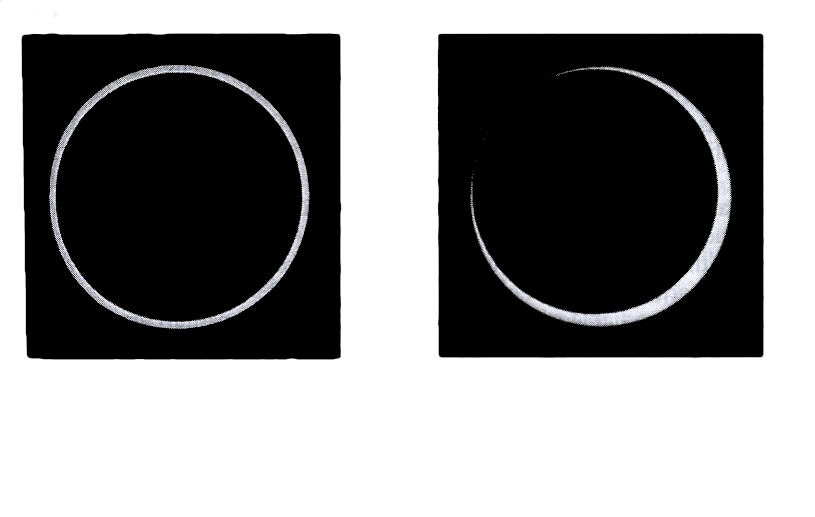
Annular solar eclipse, picture taken by RASC member Roy Bishop in 1994 near Sambro, Nova Scotia.

This image of the transit of Venus was taken by Murray Paulson, of St. Albert, Alberta, at Hersonissos, Greece, on June 8, 2004
Both images taken from the Observer's Handbook 2012 published by The Royal Astronomical Society of Canada, editor David Chapman, printed in Canada by Webcom, Inc.
Subscribe to:
Posts (Atom)