Showing posts with label science. Show all posts
Monday, February 22, 2016
No snow this year.
So far this winter, we've had no snow to shovel. Yes, there has been the odd dusting, but judicious use of "presalting" kept the sidewalks clear and prevented "black ice". What little snow there was usually melted away by mid-day. Right now, as I type this, we've had a local shower, but the sun is shining through the clouds with a nice rainbow visible right through our front window:
Usually, when snow is more plentiful, shoveling is required. On those occasions, I wish the snow would stay in the local mountains, where it belongs. Well, this year that's what seems to have happened. There is a lot of snow in the mountains; the local ski hills have been open since November and are going strong.
There have been few clear nights for astronomy. None-the-less, I have been involved in a couple of related activities. At Telus Science World, the RASC (Royal Astronomical Society of Canada) Vancouver Centre sets up displays once a month for scheduled high school classes from various local and province-wide schools. We have videos, telescopes, handouts, and answer inquiries from teachers and students alike, which may result in setting up in-school astronomy events for those schools. We also give talks to a groups of girl scouts and boy scouts, again with telescope displays. If the weather permits, we use either one or more solar telescope or, after dark, regular telescopes to look at planets, the Moon, star clusters and nebulae.
Last Friday (unfortunately it rained again), I had made arrangements with Professor Trottier to show our two granddaughters the new Trottier Observatory at Simon Fraser University. Howard Trottier is professor of physics at SFU, and the Trottier foundation donated the funds for the observatory and the Trottier Studio for innovative science education at SFU. Professor Trottier is also a past president of the RASC Vancouver Centre (as I am) and originated Starry Nights at SFU, in which the RASC participates with its support. Here are some pictures:
As you can see, no snow (but plenty of rain).
Saturday, August 22, 2015
A busy summer
Hard to believe that I last posted two months ago. Time flies.
This summer, considering the long dry spell and reasonably clear sky, I've been busy astronomically. The new Trottier observatory at SFU has taken some of my time, along with a number of public astronomy events organized by both SFU and the Royal Astronomical Society of Canada's Vancouver centre. These events, for instance "Starry Night" at SFU, the Regional Parks' Perseid Meteor shower watch in Aldergrove, Deas Island Park, and other local activities all involved the RASC and it's various volunteers.
During the last couple of months, we set up our telescopes for the public to see objects such as the Moon, the planets Saturn, Venus, and Mars, open and globular star clusters, far-away galaxies, nebulae, and exploded stars. Many thousands of people took part in these activities. The Public has a deep interest in things astronomical. It is particularly gratifying to see so many young people show up at these gatherings. It is the first step to get involved in science, because astronomy involves many disciplines (physiscs, chemistry, biology, geology, for example).
Here is a link to an article, as it appeared on the website of the RASC (http://rasc-vancouver.com/) regarding the opening of Simon Fraser University’s Trottier Observatory and Science Courtyard. It describes the manifold purposes of this great addtion to the university and the co-operation between SFU and the RASC, written by professor Howard Trottier:
http://rasc-vancouver.com/trottier-observatory-and-science-courtyard-at-sfu-wheels-up/
Many thanks are owed to the Trottier family, whose generous gift contributes so much to the scientific community.
This summer, considering the long dry spell and reasonably clear sky, I've been busy astronomically. The new Trottier observatory at SFU has taken some of my time, along with a number of public astronomy events organized by both SFU and the Royal Astronomical Society of Canada's Vancouver centre. These events, for instance "Starry Night" at SFU, the Regional Parks' Perseid Meteor shower watch in Aldergrove, Deas Island Park, and other local activities all involved the RASC and it's various volunteers.
During the last couple of months, we set up our telescopes for the public to see objects such as the Moon, the planets Saturn, Venus, and Mars, open and globular star clusters, far-away galaxies, nebulae, and exploded stars. Many thousands of people took part in these activities. The Public has a deep interest in things astronomical. It is particularly gratifying to see so many young people show up at these gatherings. It is the first step to get involved in science, because astronomy involves many disciplines (physiscs, chemistry, biology, geology, for example).
Here is a link to an article, as it appeared on the website of the RASC (http://rasc-vancouver.com/) regarding the opening of Simon Fraser University’s Trottier Observatory and Science Courtyard. It describes the manifold purposes of this great addtion to the university and the co-operation between SFU and the RASC, written by professor Howard Trottier:
http://rasc-vancouver.com/trottier-observatory-and-science-courtyard-at-sfu-wheels-up/
Many thanks are owed to the Trottier family, whose generous gift contributes so much to the scientific community.
Wednesday, June 24, 2015
Catch up
On June 20, the Moon, Jupiter, and Venus appeared in the evening sky as pictured. Venus has been chasing Earth since the beginning of the year and is slowly catching up. Jupiter has moved from the middle of the night into the evening sky (largely due to Earth's motion around the sun - it's an effect of perspective).
Venus is the closest planet to us and orbits the sun inside the Earth's orbit, and therefore moves faster. It is almost the same size as Earth, but its surface is submerged in an atmosphere which is about 90 times denser then Earth's. It's surface temperature is about 450 degrees C (900 F). It's a true hell (lead melts).
Jupiter is our solar systems largest planet. You could put about 1500 planets of Venus size into Jupiter. That huge planet orbits 5 times as far from the sun as the Earth. In this image, Jupiter is positioned on the far side of its orbit, and will disappear behind the sun in a couple of months. At this point, it is about six-and-a-half times as far away from us as the sun.
In the spirit of catching up: On the third of May we commemorated the 4th anniversary of our son's death from colon cancer - always an occasion for some tears.
On May 22nd, I turned 76. It's hard to believe, I still think that I'm in my prime. The little aches and pains accompanying old age say otherwise, however. So the truth is that I'm an old "fuddy-duddy". On May 29, I had a colonoscopy done, in view of our family history. Three polyps were found and removed. Fortunately, none of them showed any evidence of cancer.
Right now, both my wife and I are fighting a persistent cough; it makes sleeping restless. It's been making the rounds in our family - we're the last ones to "catch the bug".
At the moment, I'm involved in a process arranging the running of the new SFU astronomical observatory for it's portion of the Vancouver RASC's* time on the telescope. It's an observatory dedicated to both individual and public observing. More about this in a later post.
*Royal Astronomical Society of Canada
Saturday, February 21, 2015
A matter of perspective
There was a nice combination of the Moon, Mars, and Venus visible in the West last evening. This picture was cropped from original, taken with 200mm lens, ASA 800, 1/20 sec, handheld. Moon, Mars, and Venus aligned in evening sky. The Moon (top) is closest (360,000km), Venus (bottom) is about 213 million km away, and Mars (middle) 330 Million km.
The relative positions of the planets in February 2015 are shown in the scanned image at the bottom. The Earth is shown in green. Imagine yourself looking from the Earth towards Venus and Mars. Yesterday (February 20 around 7:30 pm) you would have seen the two planets aligned as shown below, located far beyond the Moon (the little black dot labelled "Moon"). The orbits are not to scale. If the picture were drawn to scale, Venus would be about 3 meters and Mars 4.6 meters from the Earth.
Orbit schematic scanned from Sky and Telescope magazine.
Friday, October 10, 2014
Mushroom "Forest"
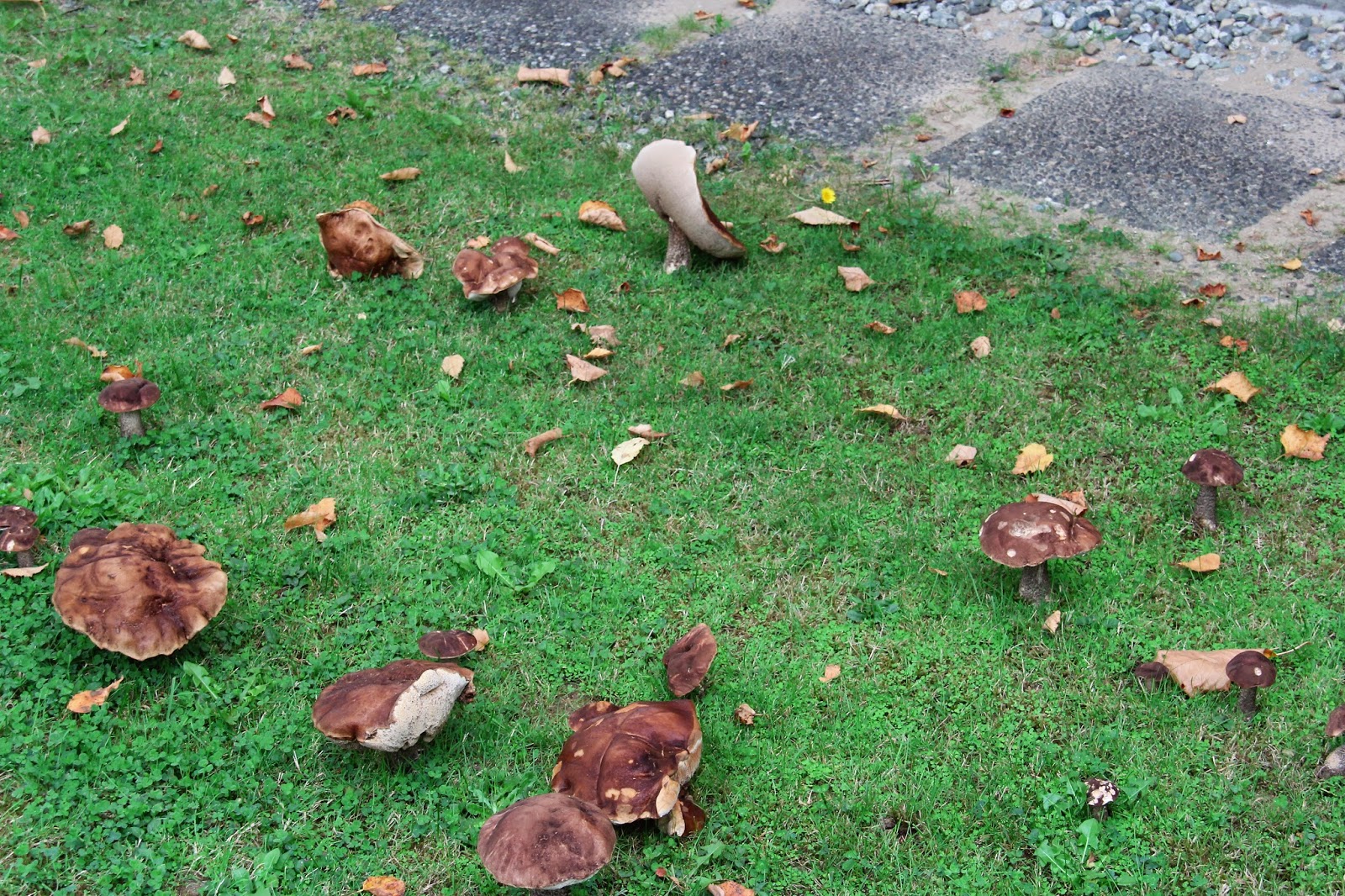
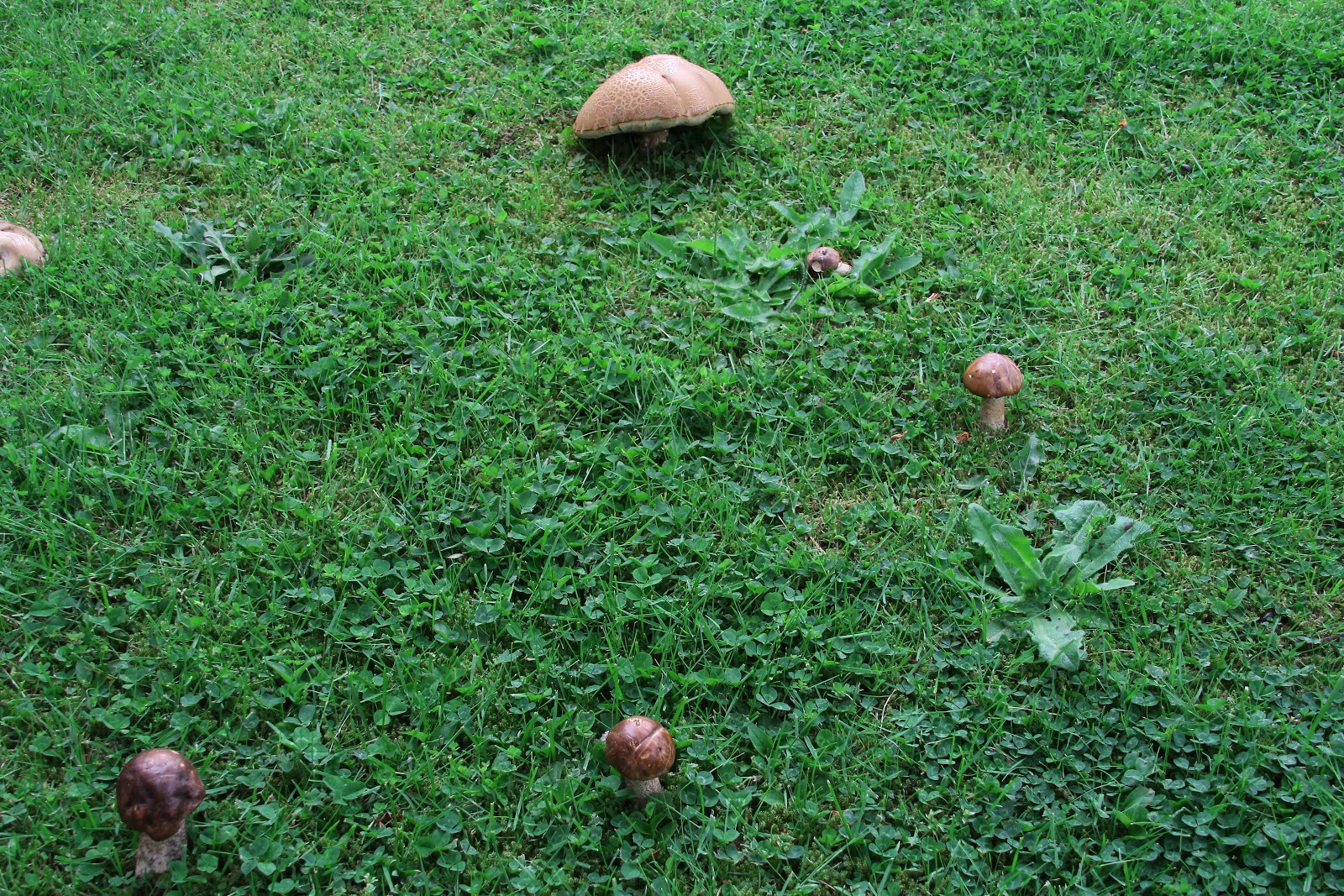
We have a couple of dozen or so mushrooms growing in our lawn again. This happens every year. I don't know whether they are edible (personally, I don't eat mushrooms). In any case, they are important or the well-being of the trees (they are a catalyst in the storage of nitrogen in the soil).
A made a reference to the "mushroom cycle" in May of last year: http://penmachinedad.blogspot.ca/2013/05/the-fixer.html
I'm always astounded when these mushrooms appear quite suddenly, apparently "out of nowhere".
Nature is amazing.
Wednesday, May 22, 2013
The "Fixer"
A couple of days ago, a few of these mushrooms appeared in our "lawn" (mostly clover, as you can see). Mushrooms appear every year there, and they have an important function: they are a catalyst in atmospheric nitrogen transformation for use by plant and tree roots. This is a two-way street. The mushrooms, in turn, benefit by having access to plant sugars and nutrients.
Here's the nitrogen "fixation" cycle, as taken from Google images:
As shown, there are other plants which do this kind of "work". In our case, the mushrooms shown above are located in the roots of our cherry tree - maybe we'll get some of those cherries later on in the year, before the birds rob them all.
Monday, May 28, 2012
Beautiful day for (solar) astronomy
The Sun in Hα light
Image taken on May 14 through my solar telescope
(click on picture to enlarge)
Most people had never seen the sun "in this light". The Sun is mostly Hydrogen gas, and Hα telescopes are "tuned" to exactly the frequency of the light emitted by hot Hydrogen, you see only the part of the Sun made of hydrogen. There is an immense amount of detail - prominences on the sun's edge, dark stripes on the sun (these are actually prominences seen 'from the top', against the brighter surface of the sun), bright flare areas, and sunspots. Many questions were asked; I'm sure that a lot of people walked away with a "new awareness" regarding the heavenly body which is the basis for life on earth (including us).
There was also an important announcement made: SFU will build an astronomical observatory for both science research and public outreach. The RASC will be part of this effort.
It was a great day for looking at the sun. SFU did a great job.
Monday, March 26, 2012
Parks Astronomy
This last Saturday, the Vancouver Parks Board set up a public evening called "Night Quest" at the Pacific Spirit Regional Park. It involved naturalists talking about creatures of the night, and also included sky watching. To that end, the Vancouver Centre of the Royal Astronomical Society of Canada (RASC) was invited to participate. We had about 10 of our members (including me) set up telescopes in a parking lot which unfortunately is surrounded by trees and affords access to only a limited area of the sky. None-the-less, we could look at the planets Venus and Jupiter through the trees (no leaves yet), and occasionally also see the Moon. There were hundreds of people who got a glimpse of these through one or the other of the telescopes. My own scope was trained on Venus all evening. At the moment, Venus is in a position of its orbit around the Sun (as seen from Earth) which makes it look through a telescope like the first quarter moon. Many people mistook it for the Moon at first glance, and were amazed to see that Venus could look like that. Lively discussions followed regarding why such a thing happens. I think some people gained a much better appreciation of the geometry of our solar system.
Later, clouds covered up the sky, and we put our telescopes away. Just as the event ended at its scheduled time, the sky started to clear up again. We get suckered in like that quite often in this city.
I enjoyed the evening, explaining things astronomical to the public. I find that this is what I like most about doing astronomy now: public events, or astronomy nights with other members at our standard venues. These events are all open to the public. The scientific contributions I used to make when I was in my teens and twenties (mostly regarding variable stars) are no longer my main interest in that field.
Some additional information about things astronomical, not necessarily involving Vancouver Parks:
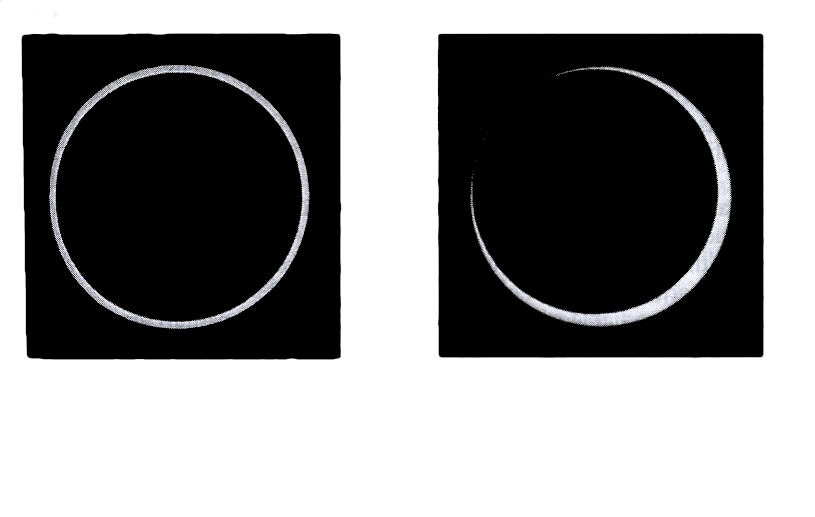
There are several interesting astronomical events coming up this year. Two interesting ones are an "annular" eclipse of the Sun late in the afternoon on May 20 and a transit of Venus across the Sun (again, as seen from Earth). The best place to see the annular eclipse would be for us to go to Redding, California, or Reno, Nevada, but we'll see a partial solar eclipse from Vancouver, too. The other event, the transit of Venus directly across the Sun on June 6, will again happen late in the afternoon. It will be visible from Vancouver, starting about 5 pm, and lasting into sunset. Spanish Banks or any place with an open view of the Salish Sea (Georgia Straight) is a good spot from which to observe. This is the second of a pair of transits 8 years apart. The last one (the first of this pair) occurred on June 8, 2004. The first one of the next pair happens on December 11, 2117, the second one of that pair on Dec 8, 2125. I don't think that I'll wait for those.
Annular solar eclipse, picture taken by RASC member Roy Bishop in 1994 near Sambro, Nova Scotia.

This image of the transit of Venus was taken by Murray Paulson, of St. Albert, Alberta, at Hersonissos, Greece, on June 8, 2004
Both images taken from the Observer's Handbook 2012 published by The Royal Astronomical Society of Canada, editor David Chapman, printed in Canada by Webcom, Inc.
Later, clouds covered up the sky, and we put our telescopes away. Just as the event ended at its scheduled time, the sky started to clear up again. We get suckered in like that quite often in this city.
I enjoyed the evening, explaining things astronomical to the public. I find that this is what I like most about doing astronomy now: public events, or astronomy nights with other members at our standard venues. These events are all open to the public. The scientific contributions I used to make when I was in my teens and twenties (mostly regarding variable stars) are no longer my main interest in that field.
Some additional information about things astronomical, not necessarily involving Vancouver Parks:
There are several interesting astronomical events coming up this year. Two interesting ones are an "annular" eclipse of the Sun late in the afternoon on May 20 and a transit of Venus across the Sun (again, as seen from Earth). The best place to see the annular eclipse would be for us to go to Redding, California, or Reno, Nevada, but we'll see a partial solar eclipse from Vancouver, too. The other event, the transit of Venus directly across the Sun on June 6, will again happen late in the afternoon. It will be visible from Vancouver, starting about 5 pm, and lasting into sunset. Spanish Banks or any place with an open view of the Salish Sea (Georgia Straight) is a good spot from which to observe. This is the second of a pair of transits 8 years apart. The last one (the first of this pair) occurred on June 8, 2004. The first one of the next pair happens on December 11, 2117, the second one of that pair on Dec 8, 2125. I don't think that I'll wait for those.
Annular solar eclipse, picture taken by RASC member Roy Bishop in 1994 near Sambro, Nova Scotia.

This image of the transit of Venus was taken by Murray Paulson, of St. Albert, Alberta, at Hersonissos, Greece, on June 8, 2004
Both images taken from the Observer's Handbook 2012 published by The Royal Astronomical Society of Canada, editor David Chapman, printed in Canada by Webcom, Inc.
Tuesday, December 13, 2011
The December 10, 2011 lunar eclipse
Any hobby usually requires some "sacrifice". In my case, astronomy normally requires that I be awake and up while it's dark outside (the exception is when I'm using my telescopes to look [safely] at the Sun). A lunar eclipse always takes place when the Moon is full; the Moon is always exactly opposite the Sun then. At this time of year, the Sun rises low in the SE. That means that the Moon sets high in the NW.
This month's lunar eclipse occurred a couple of hours before sunrise, and I could watch it through my west-facing office window. I set up one of my cameras (a Canon Rebel XT SLR) and took some pictures through the double-paned window, and through breaks in the clouds. Before the eclipse started, the sky had been absolutely clear, but, just around the start of the eclipse, heavy clouds began to roll in. This is Vancouver, after all. Midway through the eclipse they totally obliterated any view of the eclipsed Moon. I got only one good picture through the last cloud break. These clouds kept the day dark and gray right through the next night, until the next morning.
Here are some of the pictures:
From the top down:
This month's lunar eclipse occurred a couple of hours before sunrise, and I could watch it through my west-facing office window. I set up one of my cameras (a Canon Rebel XT SLR) and took some pictures through the double-paned window, and through breaks in the clouds. Before the eclipse started, the sky had been absolutely clear, but, just around the start of the eclipse, heavy clouds began to roll in. This is Vancouver, after all. Midway through the eclipse they totally obliterated any view of the eclipsed Moon. I got only one good picture through the last cloud break. These clouds kept the day dark and gray right through the next night, until the next morning.
Here are some of the pictures:
From the top down:
![]() |
| The Moon before entering Earth's shadow. The area at "11 o'clock" is getting darker. |
![]() |
| Clouds are rolling in. |
![]() |
| Three quarters into the Earth's shadow. Picture taken through a break in the clouds. |
![]() |
| About 5 minutes before "totality" (again a break in the clouds). The star under the Moon is Iota Tauri (Iota in the constellation of Taurus, the bull) |
![]() |
| The last "hole" in the clouds. The clouds to the right of the dark tree covered the Moon a short time later. |
Saturday, August 13, 2011
Public Astronomy
I'm going to help with this event by setting up a couple of telescopes.
Here are details:
Metro Parks Starry Nights at Deas Island
is happening today
Saturday, August 13, 2011
6:30 PM
Deas Island
River Road and 62B st,
Delta, BC V3M 0A2
10 Astronomy buffs
Weather permitting, on August 13th several RASC volunteers will bring telescopes to Metro Parks’ Starry Night 2011 event on Deas Island.
Bring the kids for a fun evening with (hopefully) a bit of stargazing.
Here’s a link to Metro Parks'
information poster on the event; the following information is taken from the poster:
Starry Night
Deas Island Regional Park, Delta
Saturday, August 13, 2011
6:30 - 9:30 pm
Enjoy an enchanted evening illuminated by starlight and lanterns. Stroll the lantern lit paths, join the drumming circle and discover the park at night. Allow 1hr to complete the walk. Bring a flashlight.
Presented by the Corporation of Delta, Parks, Recreation and Culture in Partnership with Metro Vancouver.
Everyone welcome
www.metrovancouver.org
Sponsors & Perks:
RASC-Vancouver ·
Here are details:
Metro Parks Starry Nights at Deas Island
is happening today
Saturday, August 13, 2011
6:30 PM
Deas Island
River Road and 62B st,
Delta, BC V3M 0A2
10 Astronomy buffs
Weather permitting, on August 13th several RASC volunteers will bring telescopes to Metro Parks’ Starry Night 2011 event on Deas Island.
Bring the kids for a fun evening with (hopefully) a bit of stargazing.
Here’s a link to Metro Parks'
information poster on the event; the following information is taken from the poster:
Starry Night
Deas Island Regional Park, Delta
Saturday, August 13, 2011
6:30 - 9:30 pm
Enjoy an enchanted evening illuminated by starlight and lanterns. Stroll the lantern lit paths, join the drumming circle and discover the park at night. Allow 1hr to complete the walk. Bring a flashlight.
Presented by the Corporation of Delta, Parks, Recreation and Culture in Partnership with Metro Vancouver.
Everyone welcome
www.metrovancouver.org
Sponsors & Perks:
RASC-Vancouver ·
Thursday, August 4, 2011
Lack of understanding
I'm just reading an article in the Vancouver Sun titled "Dark side of the moon enigma solved?" It's astonishing to me, considering that we live in the age of space travel, that people still think that there is a "dark side". Everyone has seen that the moon always presents the same face to us, as it orbits around the Earth once a month (the word "month" comes from "moon"). This means that the moon turns around it's own axis of rotation once a month as well, as seen from a point outside the moon's orbit. This also means that sunlight illuminates every part of the moon in turn, as the moon travels around the Earth, just as most parts of the Earth receive sunlight every day. The side of the moon we never see from Earth is called the "far side", not the "dark side"; it gets it's sunshine just like the rest of the moon.
To see this kind of misunderstanding perpetuated in a reputable newspaper is lamentable. In my opinion, it shows a very limited knowledge of our place in the universe and a lack of scientific understanding.
Friday, July 15, 2011
Evolution is dumb.
Every day, I think of Derek. His death on May 3 seems such a waste. He was killed by the rogue colorectal cancer cells in his body, which were the descendants of one cell. This mutated cell did not stop replicating, its descendants eventually invaded many of Derek's other organs, rendering them dysfunctional.
Derek's death also meant the death of those cancer cells, certainly not advantageous to them. I fail to see any purpose in this.
In addition, the we all lost a man with a brilliant mind who helped others in so many ways, both in person, and with his online writing. The many comments on his blog (www.penmachine.com) attest to that. His presence contributed to the betterment of humanity in many ways. His loss, therefore, is also a loss for all who knew him, intimately or casually. Again, I feel to see any logic in this.
In general, evolution has the connotation of progress. In reality, to me, evolution seems to be based on random changes at random times for random causes, the vast majority of which are detrimental to any organism involved. I suppose that this is a manifestation of the increasing entropy to which the second law of thermodynamics refers. Only very occasionally, by random happenstance, do these random changes result in an improvement for, or, even more rarely, the creation of an organism. It is only because there has been an immensely long time available (billions of years), that these very rare "good" mutations "accumulated" to form the life forms we see here on Earth. This may be a point to consider when talking about "extraterrestrial" life. What is hard to construct is easy to destroy. Disorder is far more likely than order.
Evolution has no directed purpose; it is not intelligent.
Derek's death also meant the death of those cancer cells, certainly not advantageous to them. I fail to see any purpose in this.
In addition, the we all lost a man with a brilliant mind who helped others in so many ways, both in person, and with his online writing. The many comments on his blog (www.penmachine.com) attest to that. His presence contributed to the betterment of humanity in many ways. His loss, therefore, is also a loss for all who knew him, intimately or casually. Again, I feel to see any logic in this.
In general, evolution has the connotation of progress. In reality, to me, evolution seems to be based on random changes at random times for random causes, the vast majority of which are detrimental to any organism involved. I suppose that this is a manifestation of the increasing entropy to which the second law of thermodynamics refers. Only very occasionally, by random happenstance, do these random changes result in an improvement for, or, even more rarely, the creation of an organism. It is only because there has been an immensely long time available (billions of years), that these very rare "good" mutations "accumulated" to form the life forms we see here on Earth. This may be a point to consider when talking about "extraterrestrial" life. What is hard to construct is easy to destroy. Disorder is far more likely than order.
Evolution has no directed purpose; it is not intelligent.
Friday, June 3, 2011
Return what you borrowed
A month ago today, our son Derek died. His ashes will be dispersed in a couple of places on Earth which he considered to be some of the most beautiful.
We are all made of "star stuff"- the original hydrogen, and most of the other atoms generated eons ago in some stupendous explosion of a supernova. Our existence may be considered to be an assembly of these various atoms into the molecules which constitute you, me, Earth, and all the animals and things that surround us. When we die, these are all returned to some place in this universe - perhaps to become part of some other intelligent entity eons from now.
It is possible to say, then, that we only "borrow" the building blocks of which we are made. Derek's molecules are therefore in the process of being returned to where they came from. This resonates with me.
As some of you know, I've had a life-long interest in astronomy. New stars, nebulae, and planets are constantly being formed somewhere in the universe. One of those places is the Orion Nebula, pictured above. From now on, I'll forever look at the heavens with the thought in my mind that some of these future objects will incorporate some of the same atoms and molecules which were once a part of Derek.
We'll all return what we borrowed.
We are all made of "star stuff"- the original hydrogen, and most of the other atoms generated eons ago in some stupendous explosion of a supernova. Our existence may be considered to be an assembly of these various atoms into the molecules which constitute you, me, Earth, and all the animals and things that surround us. When we die, these are all returned to some place in this universe - perhaps to become part of some other intelligent entity eons from now.
It is possible to say, then, that we only "borrow" the building blocks of which we are made. Derek's molecules are therefore in the process of being returned to where they came from. This resonates with me.
(pictured by the Hubble Space Telescope)
We'll all return what we borrowed.
Friday, April 1, 2011
A little cheer on a dreary day
As many of you know, I'm interested in Astronomy. Accordingly, above is a picture of a "Stargazer Lily" http://en.wikipedia.org/wiki/Lilium_%22Stargazer%22, of which we have some sitting in a vase on our living room table. Notice the "liquid sugar" on the stem to lure insects, I would think. That's probably what gives these flowers their heavily sweet odour, which seems to be particularly noticeable in the evenings. Click on the picture for a larger image.
Below is a picture of the camelia "bush" in our neighbours' back yard - these blossoms were not there yesterday. Click on the image.
This has been a rather unpleasant week, and not just because of the weather. Derek has not been feeling well, and yesterday we received notice that a very good friend of ours, Al, had died. We've known Al and Ernie, his lifelong partner (over 55 years), for more than 25 years. Al was almost 85 years old, and he had not been in shape for the last four years. A sad day for all of us who knew Al.
I posted these pictures to show that there is always something beautiful in nature. A little cheer on a dreary day...
Sunday, March 27, 2011
All talk-little action
Last night, "Earth Hour" passed with nary a difference in our neighbourhood. We put out all lights in our house, turned off the TV and computers, lit up some candles, and had a glass of wine. Before the earth hour we had watched an episode of the "Cosmos" (Derek gave us the CD series for Christmas), and discussed the subject of that episode ("Backbone of the Night") while the lights were out.
Occasionally, I looked out of our front window to see whether other people had turned off any lights - nobody else seemed to have done so. Windows were still lit, outdoor lights were on, and the clouds were as bright as ever from the stray city lights.
For all the talk about preserving the environment, cutting energy consumption, making a smaller "footprint" on our planet, our neighbourhood at least gets a failing grade in that regard from me.
Occasionally, I looked out of our front window to see whether other people had turned off any lights - nobody else seemed to have done so. Windows were still lit, outdoor lights were on, and the clouds were as bright as ever from the stray city lights.
For all the talk about preserving the environment, cutting energy consumption, making a smaller "footprint" on our planet, our neighbourhood at least gets a failing grade in that regard from me.
Sunday, February 20, 2011
The solar flare of Monday, Feb 14
Near the centre of the image is the white flare which sent a massive amount of energy to Earth a couple of days ago.
I looked at the Sun through my Hα telescope yesterday but the flare is not visible in Hα light; however, the disturbed area where it originated on the Sun is. In particular, the "striations" at the centre of this image are visible in Hα.
ultraviolet image
Image from SDO/NASA
Caution: Never look at the Sun with the naked eye! All events on the Sun must be viewed through special protective filters; these reduce the light to about one thousandth of one percent (=1/100,000).
Here's a pertinent article published by National Geographic Magazine:
Ted Chamberlain
Published February 16, 2011
The most powerful solar flare in four years exploded over the sun late Monday, according to NASA.
The magnetic instability that caused the flare also unleashed a blast of charged particles that should hit Earth's atmosphere tonight, possibly sparking auroras farther south than usual, experts say.
(Video: Solar Flare Causes "Sunquakes.")
The most powerful explosions in the solar system, solar flares occur when magnetic field lines on the sun cross, cancel each other out, then reconnect.
These "explosive reconnections" release huge amounts energy as heat—in this case, a short blast measuring roughly 35 million degrees Fahrenheit (19 million degrees Celsius), according to physicist Dean Pesnell, project scientist forNASA's Solar Dynamics Observatory, or SDO.
In visible light, only the small dark surface blotches of sunspot 1158, which spawned the flare, could be seen. Without the SDO satellite, "you would never have known what was happening above" the sunspot, Pesnell said.
But the satellite's ability to detect many wavelengths of light allowed the observatory to image not only the flash, in extreme ultraviolet, but also streams of charged gas arcing along magnetic field lines—a "perfect example of solar physics." (See a January picture of a large solar flare.)
Not that SDO is perfect. Its digital-imaging hardware, for example, was overwhelmed by the intensity of the flare, resulting in overexposed areas that make the flare look bigger than it was.
Imaged flawlessly, the flare, at its most intense, would "look like a ball of light floating above the surface," Pesnell said, "about the size of a house."
(See pictures of solar eruptions.)
Solar Flare Plus Aurora-Inducing "Wind"?
Monday's fleeting magnetic breakdown also sent "a firehouse of material spraying out from the sun" when "spring loaded" streams of charged gases were freed from the magnetic fields that hold them in place on the sun.
Such so-called coronal mass ejections can pose radiation threats to astronauts and overwhelm Earth's magnetic field, potentially disrupting satellite communications and power grids on the ground.
But the solar gale now heading our way isn't expected to be particularly harmful. That's because, according to predictions, "it won't hit us dead-on," Pesnell said.
Still, he said, strong geomagnetic activity is expected Wednesday night, perhaps most visibly in the form of auroras—the southern and northern lights, which occur when atoms above Earth's gain energy from solar charged particles, then release it as light.
The U.S. Space Weather Prediction Center, he said, forecasts a 30 percent chance of auroras as far south as Washington, D.C.
Stargazers below the northern U.S. should look for a diffuse reddish glow, however, rather than the neon-hued "curtains" seen around the Poles. Furthermore, the nearly full moon will effectively dim any auroras Wednesday night.
X-Rated Solar Flare
Monday's blast was the first X-level solar flare since December 2006—X being the highest level of the flare-rating system.
But at X2.2—or 0.00022 watts per square meter—the Valentine's Day flare wasn't unexpectedly powerful.
"It fits in just perfect" with forecasts that show the sun entering a period of increased activity, Pesnell said.
The recent explosion, he added, has nothing on the giant blasts of the early 2000s. That most recent active period spawned the biggest solar flare on ever directly measured in November 2003—a blast more than ten times as powerful as Monday's.
Compared to that "big honker," he said, this week's flare "is pretty typical—except it was beautifully typical, because we saw it with SDO."
For more on solar flares, sunspots, and solar wind, read "The Sun—Living With a Stormy Star," from National Geographic magazine >>
Monday, January 10, 2011
Other "Earths"
For many years, astronomers, physicists, geologists, and scientists in other disciplines, as well as science fiction writers, have speculated whether there are planets circling other stars, much like our star (the Sun) has a retinue of large and small planets circling it. Our Earth is one of those planets. The ultimate aim is to establish whether there are other planets (exoplanets - not part of our solar system) which could perhaps have liquid water on their surfaces. We see liquid water as the absolute basic necessity for life as we know it, although we are beginning to see variations of life even here on Earth which may perhaps lead us to a possibility for other life forms, not necessarily requiring water.
In any case, the underlying reason to look for Earth-like planets elsewhere is to come up with a reason to think that life is present throughout the universe (at the moment, we have absolutely no evidence that life exists elsewhere). Exoplanets have been known to exist for a couple of decades or so, but they are very hard to detect and the first ones we knew about were extremely large and could be called "failed stars".
There are a number of telescopes in orbit which are specifically designed to look for the extremely small effects which such planets have on their "suns".
http://www.astro.ubc.ca/MOST/ - This is a Canadian project, directed by Dr. Jaymie Matthews of UBC, which has detected some exoplanets as a serendipitous byproduct of its main mission (to measure tides and wave propagation in distant stars).
There are orbital telescopes specifically designed to look for exoplanets, and one in particular is designed to look for Earth-sized ones. Here's a link:
http://en.wikipedia.org/wiki/Kepler_Mission
It has just succeeded in detecting one exoplanet which is just slightly larger than Earth, albeit unlikely to be earth-like. This is the news release from NASA:
http://www.jpl.nasa.gov/news/news.cfm?release=2011-007&cid=release_2011-007&msource=11007&tr=y&auid=7605855
In any case, the underlying reason to look for Earth-like planets elsewhere is to come up with a reason to think that life is present throughout the universe (at the moment, we have absolutely no evidence that life exists elsewhere). Exoplanets have been known to exist for a couple of decades or so, but they are very hard to detect and the first ones we knew about were extremely large and could be called "failed stars".
There are a number of telescopes in orbit which are specifically designed to look for the extremely small effects which such planets have on their "suns".
http://www.astro.ubc.ca/MOST/ - This is a Canadian project, directed by Dr. Jaymie Matthews of UBC, which has detected some exoplanets as a serendipitous byproduct of its main mission (to measure tides and wave propagation in distant stars).
There are orbital telescopes specifically designed to look for exoplanets, and one in particular is designed to look for Earth-sized ones. Here's a link:
http://en.wikipedia.org/wiki/Kepler_Mission
It has just succeeded in detecting one exoplanet which is just slightly larger than Earth, albeit unlikely to be earth-like. This is the news release from NASA:
http://www.jpl.nasa.gov/news/news.cfm?release=2011-007&cid=release_2011-007&msource=11007&tr=y&auid=7605855
(Artist's concept, NASA news release)
It'll have a profound impact on human thinking if we ever find another planet on which intelligent beings are present. If we ever get into direct contact with such a "civilization" the course of human evolution may be permanently altered.
Monday, December 27, 2010
Nostalgia
We celebrated our family Christmas with a wonderful dinner at my sister-in-law's again this year. There were also plenty of presents - practical for the adults and appropriate ones for the young ones. Among the presents we received I'd like to single out just one: Derek, Airdrie, Marina, and Lauren gave us a set of DVDs of the great series "Cosmos" by Dr. Carl Sagan. At the time it was first broadcast on TV (about 1980), Derek (who was then eleven years old) and I watched it with great fascination and admiration. It left a lasting impression on both him and me (See Derek's blog here: http://www.penmachine.com/2010/11/save-a-step).
I just finished watching the first three episodes again - the series has lost none of its significance and is in little need of updates. These are included as visual appendices on the DVDs. I still feel as I did the first time around and am hopeful that young people, many of whom were not even born when the series aired will have a good look at it. The series is available on youtube: (http://www.youtube.com/results?search_query=cosmos+carl+sagan&aq=0). While I admire the great strides technology has made since then (I am an electronics technologist myself), I think that quite a bit of its use is superficial and will have no lasting meaning. By contrast, the Cosmos series has "staying power"; it will impart a much more realistic perspective of life to our younger generation.
Watching the "rerun" (from my perspective), I was transported back to the time I first watched it - with family memories coming to mind, along with the changes in our family since then: Derek (and our nieces) growing up, getting married, having their own families, etc. - nostalgia.
Thank you, Derek, Airdrie, Marina, and Lauren.
I just finished watching the first three episodes again - the series has lost none of its significance and is in little need of updates. These are included as visual appendices on the DVDs. I still feel as I did the first time around and am hopeful that young people, many of whom were not even born when the series aired will have a good look at it. The series is available on youtube: (http://www.youtube.com/results?search_query=cosmos+carl+sagan&aq=0). While I admire the great strides technology has made since then (I am an electronics technologist myself), I think that quite a bit of its use is superficial and will have no lasting meaning. By contrast, the Cosmos series has "staying power"; it will impart a much more realistic perspective of life to our younger generation.
Watching the "rerun" (from my perspective), I was transported back to the time I first watched it - with family memories coming to mind, along with the changes in our family since then: Derek (and our nieces) growing up, getting married, having their own families, etc. - nostalgia.
Thank you, Derek, Airdrie, Marina, and Lauren.
Sunday, November 14, 2010
More info on solar scope
Some additional information: I took some trial shots on the last clear sunny day, but found that it was nearly impossible to focus the image accurately. This is due mainly to the small screen on the Canon XT DSLR. When downloaded onto the computer and displayed on the screen, the images were somewhat out of focus.
The camera can be connected to a computer so that at the time of taking the pictures, the image is captured to the computer and displayed on the screen after a few seconds delay. The software for this is on the CD that came with the camera, and I downloaded a program from Canon which allows remote control of the camera from the computer. This way, the shutter can be released from the computer. Now I'm waiting for a clear day to experiment with that. A clear day may be a long time coming here. We're more than half way through fall; rain is the norm at this time of year. Below is an example of the "tuning" referred to in my previous post:
These are a first try - refinement is necessary.
surface details (unsharp mask in Photoshop used to sharpen the image)
prominences (lower edge - no enhancement)
Wednesday, November 3, 2010
Sun view
Today we had a sunny day. I took the chance to set up my new solar telescope (Derek wrote a blog about it - see http://www.penmachine.com/2010/10/grainy-red-sun). This time, I found enough time to experiment with using an additional etalon filter. The "double stack" of filters certainly enhances the H-alpha details on the sun. The bandwidth of this double filter is around 0.5 Angstrom. By tuning the filters it is possible accentuate various details (faculae, flares, prominences, etc.). I also got an impression of looking at the H-alpha sun in 3D. That's an illusion, but it makes the view really interesting. Below is a picture which approximates the view in the telescope.
Picture by Michael Karrer (flickr.com)
I've also come up with a system to mount a camera - when there is another chance, I'll start taking pictures.
Subscribe to:
Posts (Atom)