Here it is, September 1, and it seems that summer just started. We've had a number of very nice days, but right now the sky is cloudy and there have been periods of rain - nothing overwhelming, but enough to keep the garden watered. The gardening service we use has done the trimming of the hedges and trees. This is a once-a-year activity; it heralds the arrival of autumn.
My astronomical activities included participation in the Metro Vancouver Parks activities (Perseid meteor shower public night at the Aldergrove Park, Deas Island Island Regional Park, public and RASC activities at SFU's Trottier Observatory, etc.) I also did some solar observing, using my own H-alpha telescope. The sun never looks the same from one day to the next since this type of telescope shows the sun in hydrogen light (it looks red and shows the prominences, flares, sunspots in nice detail).
Perhaps there will be more sunny days as summer recedes.
I'm looking forward to next year's solar eclipse in Oregon. There will be discussions at the next RASC Vancouver council meeting for a member viewing trip to watch the eclipse. I mentioned the eclipse in my previous post.
Showing posts with label astronomy. Show all posts
Showing posts with label astronomy. Show all posts
Friday, September 2, 2016

Wednesday, July 6, 2016
Catch up
Since my last post in April, we spent almost the entire month of May in California. Before our trip there, my wife and I spent the day of May 3 in memory of our son Derek, who died on that day in 2011. That day will never be a happy one for us.
A couple of days later we took the car to get to San Diego, with a stop along the way to visit a good friend in Chico, California. We also happened to stay a couple of nights at a Hilton-Hotel-affiliated place called Homewood Suites. We found them to be very "user-friendly", with courteous and efficient staff, and breakfast and happy hour included in the very reasonable price of the rooms.
Our San Diego stay was with friends we've known for almost 40 years, and whose house is almost like a second home to us - we've stayed there so often. By chance, we arrived at the time when the host's nephew and a home-town friend (both of whom live in Germany and who are also our friends) were also staying at the house. These two left a couple of days after we arrived, but we had a chance to get up-to-date.
Our host is dealing with some age-related medical issues; we had come to help keep an eye on him during the time that his wife attended a family reunion in Germany. There are always local friends and neighbours dropping in too, so our time there was never boring; we've gotten to know most of these people during the years we have visited there.
On the way back, we stopped for the first night in Fresno, the next in Medford, and spent a couple of hours at Crater Lake, where we had deposited a small part of our son's ashes two years ago, following the wishes he had first expressed in 2007 (http://www.penmachine.com/2007/07/my-favourite-places-and-when-to-take-me). The day was cold (4 degrees C), but sunny. There was still an appreciable amount of snow, and the road around Crater Lake was only partially open.
Here are a couple of pictures:


We left Crater Lake around noon and drove north on highway 97 to Madras, Oregon. This is one of the places almost exactly on the centre line of the path of the August 2017 total solar eclipse. It will be the first total solar eclipse in North America since 1979. As expected, all the hotels in Madras are already fully booked for the eclipse, but the area around the city is quite flat, so the eclipse path (which is a couple of hundred kilometres wide) is accessible in a wider area. Google "Solar eclipse 2017" and you'll get all kinds of information links.

We spent our last night in Portland, Oregon, and, after battling the always busy traffic in Seattle, got home at a reasonable hour.
Since then, I have been active with my astronomical endeavours, meetings, and Royal Astronomical Society of Canada Vancouver Centre public events. The most recent was the celebration of Canada Day in Haney (unfortunately, not a sunny day). However, our various telescopes served as exhibits for the several hundred people who stopped by for a look through some of the telescopes and the free informational handouts.

A couple of days later we took the car to get to San Diego, with a stop along the way to visit a good friend in Chico, California. We also happened to stay a couple of nights at a Hilton-Hotel-affiliated place called Homewood Suites. We found them to be very "user-friendly", with courteous and efficient staff, and breakfast and happy hour included in the very reasonable price of the rooms.
Our San Diego stay was with friends we've known for almost 40 years, and whose house is almost like a second home to us - we've stayed there so often. By chance, we arrived at the time when the host's nephew and a home-town friend (both of whom live in Germany and who are also our friends) were also staying at the house. These two left a couple of days after we arrived, but we had a chance to get up-to-date.
Our host is dealing with some age-related medical issues; we had come to help keep an eye on him during the time that his wife attended a family reunion in Germany. There are always local friends and neighbours dropping in too, so our time there was never boring; we've gotten to know most of these people during the years we have visited there.
On the way back, we stopped for the first night in Fresno, the next in Medford, and spent a couple of hours at Crater Lake, where we had deposited a small part of our son's ashes two years ago, following the wishes he had first expressed in 2007 (http://www.penmachine.com/2007/07/my-favourite-places-and-when-to-take-me). The day was cold (4 degrees C), but sunny. There was still an appreciable amount of snow, and the road around Crater Lake was only partially open.
Here are a couple of pictures:

Crater Lake (taken from the air April 2016)

We dispersed some of Derek's ashes here in June 2014.

The solar eclipse pictures I took on February 26, 1979 (in Winnipeg - the "diamond ring" picture was taken by Neil Laffra on Hecla Island in Lake Winnipeg). At the time I had a complete darkroom in our basement where I developed the film and prints, and mounted them as shown. They have been hanging on our wall since then.
Since then, I have been active with my astronomical endeavours, meetings, and Royal Astronomical Society of Canada Vancouver Centre public events. The most recent was the celebration of Canada Day in Haney (unfortunately, not a sunny day). However, our various telescopes served as exhibits for the several hundred people who stopped by for a look through some of the telescopes and the free informational handouts.

Canada Day with the RASC
(one of the rare instances when no people blocked the view)
Monday, February 22, 2016
No snow this year.
So far this winter, we've had no snow to shovel. Yes, there has been the odd dusting, but judicious use of "presalting" kept the sidewalks clear and prevented "black ice". What little snow there was usually melted away by mid-day. Right now, as I type this, we've had a local shower, but the sun is shining through the clouds with a nice rainbow visible right through our front window:

Usually, when snow is more plentiful, shoveling is required. On those occasions, I wish the snow would stay in the local mountains, where it belongs. Well, this year that's what seems to have happened. There is a lot of snow in the mountains; the local ski hills have been open since November and are going strong.
There have been few clear nights for astronomy. None-the-less, I have been involved in a couple of related activities. At Telus Science World, the RASC (Royal Astronomical Society of Canada) Vancouver Centre sets up displays once a month for scheduled high school classes from various local and province-wide schools. We have videos, telescopes, handouts, and answer inquiries from teachers and students alike, which may result in setting up in-school astronomy events for those schools. We also give talks to a groups of girl scouts and boy scouts, again with telescope displays. If the weather permits, we use either one or more solar telescope or, after dark, regular telescopes to look at planets, the Moon, star clusters and nebulae.
Last Friday (unfortunately it rained again), I had made arrangements with Professor Trottier to show our two granddaughters the new Trottier Observatory at Simon Fraser University. Howard Trottier is professor of physics at SFU, and the Trottier foundation donated the funds for the observatory and the Trottier Studio for innovative science education at SFU. Professor Trottier is also a past president of the RASC Vancouver Centre (as I am) and originated Starry Nights at SFU, in which the RASC participates with its support. Here are some pictures:


As you can see, no snow (but plenty of rain).
Saturday, December 12, 2015
Busy time
I just realized that it's been more than 2 months since I last posted anything. In the meantime, I've been busy with a number of meetings as a trustee of the Vancouver Centre of the RASC, participated in several public astronomy nights (both at SFU and the HRMacMillan space centre), attended a TEDx session, and reworked the computer network in our house. Since we are a close family, we also had get-togethers (dinners, mainly).
Christmas has crept up again, the tree is now up, and our granddaughters set up the "village" again. As always, we'll miss our son Derek at our family Christmas celebration. This will be the 5th Christmas since he died.
Since I probably won't blog again until next year, we wish everyone a "Very Merry Christmas" and a Happy, Healthy, and Successful New Year.


Saturday, August 22, 2015
A busy summer
Hard to believe that I last posted two months ago. Time flies.
This summer, considering the long dry spell and reasonably clear sky, I've been busy astronomically. The new Trottier observatory at SFU has taken some of my time, along with a number of public astronomy events organized by both SFU and the Royal Astronomical Society of Canada's Vancouver centre. These events, for instance "Starry Night" at SFU, the Regional Parks' Perseid Meteor shower watch in Aldergrove, Deas Island Park, and other local activities all involved the RASC and it's various volunteers.
During the last couple of months, we set up our telescopes for the public to see objects such as the Moon, the planets Saturn, Venus, and Mars, open and globular star clusters, far-away galaxies, nebulae, and exploded stars. Many thousands of people took part in these activities. The Public has a deep interest in things astronomical. It is particularly gratifying to see so many young people show up at these gatherings. It is the first step to get involved in science, because astronomy involves many disciplines (physiscs, chemistry, biology, geology, for example).
Here is a link to an article, as it appeared on the website of the RASC (http://rasc-vancouver.com/) regarding the opening of Simon Fraser University’s Trottier Observatory and Science Courtyard. It describes the manifold purposes of this great addtion to the university and the co-operation between SFU and the RASC, written by professor Howard Trottier:
http://rasc-vancouver.com/trottier-observatory-and-science-courtyard-at-sfu-wheels-up/
Many thanks are owed to the Trottier family, whose generous gift contributes so much to the scientific community.
This summer, considering the long dry spell and reasonably clear sky, I've been busy astronomically. The new Trottier observatory at SFU has taken some of my time, along with a number of public astronomy events organized by both SFU and the Royal Astronomical Society of Canada's Vancouver centre. These events, for instance "Starry Night" at SFU, the Regional Parks' Perseid Meteor shower watch in Aldergrove, Deas Island Park, and other local activities all involved the RASC and it's various volunteers.
During the last couple of months, we set up our telescopes for the public to see objects such as the Moon, the planets Saturn, Venus, and Mars, open and globular star clusters, far-away galaxies, nebulae, and exploded stars. Many thousands of people took part in these activities. The Public has a deep interest in things astronomical. It is particularly gratifying to see so many young people show up at these gatherings. It is the first step to get involved in science, because astronomy involves many disciplines (physiscs, chemistry, biology, geology, for example).
Here is a link to an article, as it appeared on the website of the RASC (http://rasc-vancouver.com/) regarding the opening of Simon Fraser University’s Trottier Observatory and Science Courtyard. It describes the manifold purposes of this great addtion to the university and the co-operation between SFU and the RASC, written by professor Howard Trottier:
http://rasc-vancouver.com/trottier-observatory-and-science-courtyard-at-sfu-wheels-up/
Many thanks are owed to the Trottier family, whose generous gift contributes so much to the scientific community.
Wednesday, June 24, 2015
Catch up
On June 20, the Moon, Jupiter, and Venus appeared in the evening sky as pictured. Venus has been chasing Earth since the beginning of the year and is slowly catching up. Jupiter has moved from the middle of the night into the evening sky (largely due to Earth's motion around the sun - it's an effect of perspective).
Venus is the closest planet to us and orbits the sun inside the Earth's orbit, and therefore moves faster. It is almost the same size as Earth, but its surface is submerged in an atmosphere which is about 90 times denser then Earth's. It's surface temperature is about 450 degrees C (900 F). It's a true hell (lead melts).
Jupiter is our solar systems largest planet. You could put about 1500 planets of Venus size into Jupiter. That huge planet orbits 5 times as far from the sun as the Earth. In this image, Jupiter is positioned on the far side of its orbit, and will disappear behind the sun in a couple of months. At this point, it is about six-and-a-half times as far away from us as the sun.

In the spirit of catching up: On the third of May we commemorated the 4th anniversary of our son's death from colon cancer - always an occasion for some tears.
On May 22nd, I turned 76. It's hard to believe, I still think that I'm in my prime. The little aches and pains accompanying old age say otherwise, however. So the truth is that I'm an old "fuddy-duddy". On May 29, I had a colonoscopy done, in view of our family history. Three polyps were found and removed. Fortunately, none of them showed any evidence of cancer.
Right now, both my wife and I are fighting a persistent cough; it makes sleeping restless. It's been making the rounds in our family - we're the last ones to "catch the bug".
At the moment, I'm involved in a process arranging the running of the new SFU astronomical observatory for it's portion of the Vancouver RASC's* time on the telescope. It's an observatory dedicated to both individual and public observing. More about this in a later post.
*Royal Astronomical Society of Canada
Sunday, March 22, 2015
A month later

Venus, Moon, Mars (faint dot at lower right of the Moon), Mar 21, 2015 evening
Moon, Mars (middle), Venus, on Feb 20, 2015 in the evening sky.

Click on the images for a larger view, or use Zoom option.
Saturday, February 21, 2015
A matter of perspective
There was a nice combination of the Moon, Mars, and Venus visible in the West last evening. This picture was cropped from original, taken with 200mm lens, ASA 800, 1/20 sec, handheld. Moon, Mars, and Venus aligned in evening sky. The Moon (top) is closest (360,000km), Venus (bottom) is about 213 million km away, and Mars (middle) 330 Million km.
The relative positions of the planets in February 2015 are shown in the scanned image at the bottom. The Earth is shown in green. Imagine yourself looking from the Earth towards Venus and Mars. Yesterday (February 20 around 7:30 pm) you would have seen the two planets aligned as shown below, located far beyond the Moon (the little black dot labelled "Moon"). The orbits are not to scale. If the picture were drawn to scale, Venus would be about 3 meters and Mars 4.6 meters from the Earth.


The relative positions of the planets in February 2015 are shown in the scanned image at the bottom. The Earth is shown in green. Imagine yourself looking from the Earth towards Venus and Mars. Yesterday (February 20 around 7:30 pm) you would have seen the two planets aligned as shown below, located far beyond the Moon (the little black dot labelled "Moon"). The orbits are not to scale. If the picture were drawn to scale, Venus would be about 3 meters and Mars 4.6 meters from the Earth.
Orbit schematic scanned from Sky and Telescope magazine.
Saturday, January 24, 2015
Into the New Year
My wife and I hope that all of you had a great holiday season. We enjoyed our usual Christmas family get-together. For once, the two of us had a "stay-at-home" New Year all by ourselves. After watching the New York time ball at 9pm, we raised a toast or two, reminisced about past riotous New Years' parties here at home, in California and Mexico, and family members and friends who have died, and went to bed around 10pm - getting old, I guess.
A number of astronomical events (including a relatively rare triple shadow transit on Jupiter) were rained/fogged out during this month. A clear sky break during last week made it possible for me to have a look at comet Lovejoy, though. This is a relatively bright comet, easily seen through binoculars. It's bright enough to be seen with the naked eye as a faint, fuzzy star, but not in the light-polluted Metro area.
The days are getting longer; we're looking forward to more sun.
A number of astronomical events (including a relatively rare triple shadow transit on Jupiter) were rained/fogged out during this month. A clear sky break during last week made it possible for me to have a look at comet Lovejoy, though. This is a relatively bright comet, easily seen through binoculars. It's bright enough to be seen with the naked eye as a faint, fuzzy star, but not in the light-polluted Metro area.
The days are getting longer; we're looking forward to more sun.
Monday, November 24, 2014
As time goes by...
Things have been busy lately. The RASC has been doing things astronomical - observing nights for the public and council and membership meetings, which always feature some interesting speakers. As usual, the weather ruled the success of the observing sessions; some had to be called off. The latest one of these was scheduled for the youngest group in the Boy Scouts (Beavers) in New Westminster today - but the weather gods do not agree, as you can see if you live in our area. If you are interested in astronomy, as I am, you get used to this.
Aside from my external activities, my wife and I have had some doctors' appointments - at our age, some issue or other always comes up. Well, "body and soul maintenance" is important at any age, it just becomes more necessary as time goes on.
Our daughter-in-law organized a very successful family get-together (17 people). We always have a great time and enjoy each others' company; there are none of the family frictions which seem to be the norm if you judge by the numerous TV shows which exploit that theme. We're lucky to be able to appreciate our individual traits.

Christmas is just around the corner - the year is quickly approaching its end. Something is tinkering with the speed at which time goes by, it seems to me.
Aside from my external activities, my wife and I have had some doctors' appointments - at our age, some issue or other always comes up. Well, "body and soul maintenance" is important at any age, it just becomes more necessary as time goes on.
Our daughter-in-law organized a very successful family get-together (17 people). We always have a great time and enjoy each others' company; there are none of the family frictions which seem to be the norm if you judge by the numerous TV shows which exploit that theme. We're lucky to be able to appreciate our individual traits.
Christmas is just around the corner - the year is quickly approaching its end. Something is tinkering with the speed at which time goes by, it seems to me.
Wednesday, October 8, 2014
Eclipse wipe-out
The Moon went through a total eclipse this morning (from 3:25 am to 4:24 am PDT). Before totality, as the the Moon moves into and out of the Earth's shadow, it goes through a number of stages.
The magazine "Sky and Telescope" published a very descriptive illustration of the process:

I had decided a couple of days earlier that I'd try to photograph this event. On our back porch, I set up a Canon 60Da camera with a 500mm telephoto lens on an iOptron SkyTracker mount (to compensate for the Earth's rotation during that event). The camera can be controlled via our home computer network; I'm a creature of comfort and did not want to sit out in the cool night. Instead, I watched the process on my desktop computer and took pictures as things progressed. All evening, the sky was covered with thin clouds, but the Moon was visible through them.
Here's what that looked like:
Here's what that looked like:

As the time for the eclipse approached, the clouds turned more variable, so camera exposure times had to vary with the varying transparency of the clouds. Alas, just as the time for the beginning of the "total" phase approached, the clouds got so thick that the Moon could not be seen and the sky stayed that way until late this afternoon.


Almost into totality. The clouds are quite dense. This is a 4-second exposure.
The penumbra is apparent on the left edge.
Getting into the partial phase.
Almost into totality. The clouds are quite dense. This is a 4-second exposure.


The last trace of the Moon. A couple of minutes before totality. This is a 6-second exposure. The brown tint on the clouds is the wasted light from sodium vapour street lights which pollute the sky in the lower mainland.
Can you find the Moon in this picture?
Can you find the Moon in this picture?
Being into astronomy, the weather rules. It can be frustrating. I never got to see, or photograph any part of the remainder of this eclipse. There are many good pictures of all of the eclipse on the internet, taken in parts of the country which did not have cloud problems.
This was a really badly timed wipe-out.
This was a really badly timed wipe-out.
Tuesday, December 31, 2013
An end and a beginning
Today is the last day of 2013. Let me wish everyone a Happy New Year, and all success for the future.
In addition to being the last day of the year, it is also my last "working" day. I decided at the beginning of this year that I'd shut down my business and retire at the end of the year. From now on, my business is a passive entity and exists only for so long as it takes to clean up the "loose ends", i.e. close GST and PST accounts, and collect outstanding accounts receivable, and a few other things. I will no longer actively provide the services which were the base of my business. After all these things are done, my business will no longer exist.
My wife and I are looking forward to more travels, I look forward to the pursuit of my various hobbies (astronomy, photography, electronics) and generally not having the time constraints imposed by operating a business. A big thank-you to all my loyal suppliers and customers - we've had a great business relationship.
Again, the Best to all.
In addition to being the last day of the year, it is also my last "working" day. I decided at the beginning of this year that I'd shut down my business and retire at the end of the year. From now on, my business is a passive entity and exists only for so long as it takes to clean up the "loose ends", i.e. close GST and PST accounts, and collect outstanding accounts receivable, and a few other things. I will no longer actively provide the services which were the base of my business. After all these things are done, my business will no longer exist.
My wife and I are looking forward to more travels, I look forward to the pursuit of my various hobbies (astronomy, photography, electronics) and generally not having the time constraints imposed by operating a business. A big thank-you to all my loyal suppliers and customers - we've had a great business relationship.
Again, the Best to all.
Saturday, July 20, 2013
A close paradise
Last week, we spent a few days with good friends on Saltspring Island. They have a wonderful house located near the top of a ridge, overlooking the waterways between some of the Gulf Islands.
They are great cooks, so we had some excellent meals. There were only the four of us - it was a "cozy" visit.
I took my Celestron C-8 telescope along, and, since the weather co-operated, we had a great view of the planet Saturn with its rings and moons, globular and open star clusters, and much more. The sky in the area is relatively free of light pollution, even though the "light domes" of Vancouver to the east and Victoria to the south were noticeable.
The ferry trips themselves were like "microcruises"; we tend forget how beautiful BC is - a paradise close by.
Some pictures:
Saltspring
They are great cooks, so we had some excellent meals. There were only the four of us - it was a "cozy" visit.
I took my Celestron C-8 telescope along, and, since the weather co-operated, we had a great view of the planet Saturn with its rings and moons, globular and open star clusters, and much more. The sky in the area is relatively free of light pollution, even though the "light domes" of Vancouver to the east and Victoria to the south were noticeable.
The ferry trips themselves were like "microcruises"; we tend forget how beautiful BC is - a paradise close by.
Some pictures:
Saltspring
Wednesday, November 28, 2012
Another November
The days are getting shorter, we are staying in our cozy home more often. I've had to do battle with my iMac; after it took more and more time to execute programs and commands. In the end, it took almost twenty minutes to boot up. After reading up on possible causes, erasing and reformatting the hard drive, and not making any progress, I finally fund out that this was an issue of the hard drive "deteriorating", and that Apple had acknowledged this was a "recall" issue. Apparently they have a program to replace the drive at no charge (my iMac was purchased two years ago).
So, I took the computer to the Metrotown Apple store. The service technician proceeded with a hardware testing program, which confirmed the drive problem. A work slip showing a "no charge" procedure was issued. I left the computer at the store, and was told it would ready in one or two days.
Imagine my disgust when I got a phone call a little while later informing me that the drive would not be replaced at no cost - it would cost about $280.- The reason was apparently that the hard drive was a Western Digital make instead of a Seagate model. I told the person phoning me that the hard drive was the original drive, and that this (what I thought of as a 'bait-and-switch") message left a bad taste about Apple in my mind. Since the computer was essentially useless, I reluctantly agreed to pay.
About half an hour later, I got another call from Apple - they would replace the drive under the recall procedure after all. So, I say that Apple "put the customer first" - and they deserve credit for that. It also restored my faith in the company - I'm going to be buying another portable computer soon - and Apple will be in the running.
Another notable event for us was a presentation by Dr. Sara Seager, Professor of Planetary Science and Physics at MIT. Dr. Seager is a Canadian, and one of the world's leading researchers in the theory, detection, and characterization of exoplanets. She talked about her work on Exoplanets and the Search for Habitable Worlds and how close we may be to detect possible evidence of some sort of life on an earthlike planet circling another star. There were about 300 people in attendance, ranging from young to not-so-young. Many questions were asked, especially by the young folks; Dr. Seager obviously discussed the subject at the appropriate level. My wife is only peripherally interested in Astronomy, but she said that she learned quite a bit about this subject and liked the presentation a lot.
The event was sponsored by Simon Fraser University and the Royal Astronomical Society of Canada (of which I am a life member), and took place at SFU's Goldcorp Centre in the newly redesigned Woodward Building downtown.
November is ending, Christmas is around the corner, and the young ones in our family are looking forward to it. This year seems to have gone in a flash.
So, I took the computer to the Metrotown Apple store. The service technician proceeded with a hardware testing program, which confirmed the drive problem. A work slip showing a "no charge" procedure was issued. I left the computer at the store, and was told it would ready in one or two days.
Imagine my disgust when I got a phone call a little while later informing me that the drive would not be replaced at no cost - it would cost about $280.- The reason was apparently that the hard drive was a Western Digital make instead of a Seagate model. I told the person phoning me that the hard drive was the original drive, and that this (what I thought of as a 'bait-and-switch") message left a bad taste about Apple in my mind. Since the computer was essentially useless, I reluctantly agreed to pay.
About half an hour later, I got another call from Apple - they would replace the drive under the recall procedure after all. So, I say that Apple "put the customer first" - and they deserve credit for that. It also restored my faith in the company - I'm going to be buying another portable computer soon - and Apple will be in the running.
Another notable event for us was a presentation by Dr. Sara Seager, Professor of Planetary Science and Physics at MIT. Dr. Seager is a Canadian, and one of the world's leading researchers in the theory, detection, and characterization of exoplanets. She talked about her work on Exoplanets and the Search for Habitable Worlds and how close we may be to detect possible evidence of some sort of life on an earthlike planet circling another star. There were about 300 people in attendance, ranging from young to not-so-young. Many questions were asked, especially by the young folks; Dr. Seager obviously discussed the subject at the appropriate level. My wife is only peripherally interested in Astronomy, but she said that she learned quite a bit about this subject and liked the presentation a lot.
The event was sponsored by Simon Fraser University and the Royal Astronomical Society of Canada (of which I am a life member), and took place at SFU's Goldcorp Centre in the newly redesigned Woodward Building downtown.
November is ending, Christmas is around the corner, and the young ones in our family are looking forward to it. This year seems to have gone in a flash.
Sunday, September 30, 2012
Summmer's end
This summer has been very nice, weatherwise, even though our brother-in law died a couple of months ago. We did some traveling, visiting good friends on Saltspring and in San Diego. It was a tonic to get over the family misfortunes of the last couple of years.
I purchased a new Canon model 60Da Digital SLR camera body recently. It is designed for astronomical photography (the "a" in the model number). The old lenses I have for my Canon Rebel XT fit this camera and the adapters for the old "threaded" Pentax lenses work as well. The new camera also works well for standard daylight photography.
Here are a couple of samples:

A quick star image taken from our light-polluted back yard and processed to suppress that pollution. The only stars I could see with my eyes through this light pollution were the bright one at the top and the next brightest one near the upper right corner. The camera caught the other stars in this 10-second exposure.

A bee looking for more nectar from a flower pot on our back deck. Daylight imaging is also very good. This camera allows for very flexible use.
I'm looking forward to get away from our city to the clear, unpolluted dark-sky areas for which this new camera is designed. We'll also keep in close touch with family here and hope to travel some more and visit more of our friends and family in both Europe and in the Americas. Perhaps I can combine both activities.
Life will go on.
I purchased a new Canon model 60Da Digital SLR camera body recently. It is designed for astronomical photography (the "a" in the model number). The old lenses I have for my Canon Rebel XT fit this camera and the adapters for the old "threaded" Pentax lenses work as well. The new camera also works well for standard daylight photography.
Here are a couple of samples:

A quick star image taken from our light-polluted back yard and processed to suppress that pollution. The only stars I could see with my eyes through this light pollution were the bright one at the top and the next brightest one near the upper right corner. The camera caught the other stars in this 10-second exposure.

A bee looking for more nectar from a flower pot on our back deck. Daylight imaging is also very good. This camera allows for very flexible use.
I'm looking forward to get away from our city to the clear, unpolluted dark-sky areas for which this new camera is designed. We'll also keep in close touch with family here and hope to travel some more and visit more of our friends and family in both Europe and in the Americas. Perhaps I can combine both activities.
Life will go on.
Monday, May 28, 2012
Beautiful day for (solar) astronomy

The Sun in Hα light
Image taken on May 14 through my solar telescope
(click on picture to enlarge)
Most people had never seen the sun "in this light". The Sun is mostly Hydrogen gas, and Hα telescopes are "tuned" to exactly the frequency of the light emitted by hot Hydrogen, you see only the part of the Sun made of hydrogen. There is an immense amount of detail - prominences on the sun's edge, dark stripes on the sun (these are actually prominences seen 'from the top', against the brighter surface of the sun), bright flare areas, and sunspots. Many questions were asked; I'm sure that a lot of people walked away with a "new awareness" regarding the heavenly body which is the basis for life on earth (including us).
There was also an important announcement made: SFU will build an astronomical observatory for both science research and public outreach. The RASC will be part of this effort.
It was a great day for looking at the sun. SFU did a great job.
Monday, March 26, 2012
Parks Astronomy
This last Saturday, the Vancouver Parks Board set up a public evening called "Night Quest" at the Pacific Spirit Regional Park. It involved naturalists talking about creatures of the night, and also included sky watching. To that end, the Vancouver Centre of the Royal Astronomical Society of Canada (RASC) was invited to participate. We had about 10 of our members (including me) set up telescopes in a parking lot which unfortunately is surrounded by trees and affords access to only a limited area of the sky. None-the-less, we could look at the planets Venus and Jupiter through the trees (no leaves yet), and occasionally also see the Moon. There were hundreds of people who got a glimpse of these through one or the other of the telescopes. My own scope was trained on Venus all evening. At the moment, Venus is in a position of its orbit around the Sun (as seen from Earth) which makes it look through a telescope like the first quarter moon. Many people mistook it for the Moon at first glance, and were amazed to see that Venus could look like that. Lively discussions followed regarding why such a thing happens. I think some people gained a much better appreciation of the geometry of our solar system.
Later, clouds covered up the sky, and we put our telescopes away. Just as the event ended at its scheduled time, the sky started to clear up again. We get suckered in like that quite often in this city.
I enjoyed the evening, explaining things astronomical to the public. I find that this is what I like most about doing astronomy now: public events, or astronomy nights with other members at our standard venues. These events are all open to the public. The scientific contributions I used to make when I was in my teens and twenties (mostly regarding variable stars) are no longer my main interest in that field.
Some additional information about things astronomical, not necessarily involving Vancouver Parks:
There are several interesting astronomical events coming up this year. Two interesting ones are an "annular" eclipse of the Sun late in the afternoon on May 20 and a transit of Venus across the Sun (again, as seen from Earth). The best place to see the annular eclipse would be for us to go to Redding, California, or Reno, Nevada, but we'll see a partial solar eclipse from Vancouver, too. The other event, the transit of Venus directly across the Sun on June 6, will again happen late in the afternoon. It will be visible from Vancouver, starting about 5 pm, and lasting into sunset. Spanish Banks or any place with an open view of the Salish Sea (Georgia Straight) is a good spot from which to observe. This is the second of a pair of transits 8 years apart. The last one (the first of this pair) occurred on June 8, 2004. The first one of the next pair happens on December 11, 2117, the second one of that pair on Dec 8, 2125. I don't think that I'll wait for those.

Annular solar eclipse, picture taken by RASC member Roy Bishop in 1994 near Sambro, Nova Scotia.

This image of the transit of Venus was taken by Murray Paulson, of St. Albert, Alberta, at Hersonissos, Greece, on June 8, 2004
Both images taken from the Observer's Handbook 2012 published by The Royal Astronomical Society of Canada, editor David Chapman, printed in Canada by Webcom, Inc.
Later, clouds covered up the sky, and we put our telescopes away. Just as the event ended at its scheduled time, the sky started to clear up again. We get suckered in like that quite often in this city.
I enjoyed the evening, explaining things astronomical to the public. I find that this is what I like most about doing astronomy now: public events, or astronomy nights with other members at our standard venues. These events are all open to the public. The scientific contributions I used to make when I was in my teens and twenties (mostly regarding variable stars) are no longer my main interest in that field.
Some additional information about things astronomical, not necessarily involving Vancouver Parks:
There are several interesting astronomical events coming up this year. Two interesting ones are an "annular" eclipse of the Sun late in the afternoon on May 20 and a transit of Venus across the Sun (again, as seen from Earth). The best place to see the annular eclipse would be for us to go to Redding, California, or Reno, Nevada, but we'll see a partial solar eclipse from Vancouver, too. The other event, the transit of Venus directly across the Sun on June 6, will again happen late in the afternoon. It will be visible from Vancouver, starting about 5 pm, and lasting into sunset. Spanish Banks or any place with an open view of the Salish Sea (Georgia Straight) is a good spot from which to observe. This is the second of a pair of transits 8 years apart. The last one (the first of this pair) occurred on June 8, 2004. The first one of the next pair happens on December 11, 2117, the second one of that pair on Dec 8, 2125. I don't think that I'll wait for those.
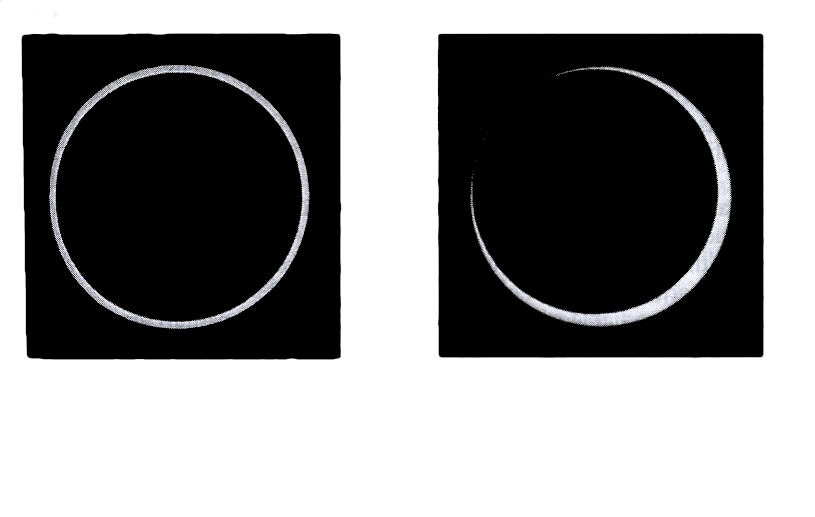
Annular solar eclipse, picture taken by RASC member Roy Bishop in 1994 near Sambro, Nova Scotia.

This image of the transit of Venus was taken by Murray Paulson, of St. Albert, Alberta, at Hersonissos, Greece, on June 8, 2004
Both images taken from the Observer's Handbook 2012 published by The Royal Astronomical Society of Canada, editor David Chapman, printed in Canada by Webcom, Inc.
Tuesday, December 13, 2011
The December 10, 2011 lunar eclipse
Any hobby usually requires some "sacrifice". In my case, astronomy normally requires that I be awake and up while it's dark outside (the exception is when I'm using my telescopes to look [safely] at the Sun). A lunar eclipse always takes place when the Moon is full; the Moon is always exactly opposite the Sun then. At this time of year, the Sun rises low in the SE. That means that the Moon sets high in the NW.
This month's lunar eclipse occurred a couple of hours before sunrise, and I could watch it through my west-facing office window. I set up one of my cameras (a Canon Rebel XT SLR) and took some pictures through the double-paned window, and through breaks in the clouds. Before the eclipse started, the sky had been absolutely clear, but, just around the start of the eclipse, heavy clouds began to roll in. This is Vancouver, after all. Midway through the eclipse they totally obliterated any view of the eclipsed Moon. I got only one good picture through the last cloud break. These clouds kept the day dark and gray right through the next night, until the next morning.
Here are some of the pictures:
From the top down:
The top picture was taken about two hours before the bottom one. It was a cold morning outside. This kind of thing did not bother me in the past, but now, in my old age, I enjoy creature comforts much more. I was glad to witness this in my nice, warm office.
This month's lunar eclipse occurred a couple of hours before sunrise, and I could watch it through my west-facing office window. I set up one of my cameras (a Canon Rebel XT SLR) and took some pictures through the double-paned window, and through breaks in the clouds. Before the eclipse started, the sky had been absolutely clear, but, just around the start of the eclipse, heavy clouds began to roll in. This is Vancouver, after all. Midway through the eclipse they totally obliterated any view of the eclipsed Moon. I got only one good picture through the last cloud break. These clouds kept the day dark and gray right through the next night, until the next morning.
Here are some of the pictures:
From the top down:
 |
| The Moon before entering Earth's shadow. The area at "11 o'clock" is getting darker. |
 |
| Clouds are rolling in. |
 |
| Three quarters into the Earth's shadow. Picture taken through a break in the clouds. |
 |
| About 5 minutes before "totality" (again a break in the clouds). The star under the Moon is Iota Tauri (Iota in the constellation of Taurus, the bull) |
 |
| The last "hole" in the clouds. The clouds to the right of the dark tree covered the Moon a short time later. |
 | |||||||||
| Midway through totality. This picture was taken just after the one above. About half-way through totality - the Moon has moved, so now is totally covered by the Earth's shadow. The brighter part of the Moon is closer to the edge of the shadow. Notice that the star Iota Tauri is now farther away from the Moon - it's a consequence of the Moon's motion in its orbit. This is my last picture of this eclipse. A minute later, the Moon was completely covered by clouds and no longer visible. The orange colour of the Moon in the Earth's shadow is due the sunlight being "refracted" by the Earth's atmosphere onto the Moon's surface. If you were on the Moon, you'd see the dark disk of the Earth surrounded by a reddish-orange ring (a circular sunset). From the Moon, this event is a total eclipse of the Sun. You'd have an awe-inspiring sight. |
Saturday, August 13, 2011
Public Astronomy
I'm going to help with this event by setting up a couple of telescopes.
Here are details:
Metro Parks Starry Nights at Deas Island
is happening today
Saturday, August 13, 2011
6:30 PM
Deas Island
River Road and 62B st,
Delta, BC V3M 0A2
10 Astronomy buffs
Weather permitting, on August 13th several RASC volunteers will bring telescopes to Metro Parks’ Starry Night 2011 event on Deas Island.
Bring the kids for a fun evening with (hopefully) a bit of stargazing.
Here’s a link to Metro Parks'
information poster on the event; the following information is taken from the poster:
Starry Night
Deas Island Regional Park, Delta
Saturday, August 13, 2011
6:30 - 9:30 pm
Enjoy an enchanted evening illuminated by starlight and lanterns. Stroll the lantern lit paths, join the drumming circle and discover the park at night. Allow 1hr to complete the walk. Bring a flashlight.
Presented by the Corporation of Delta, Parks, Recreation and Culture in Partnership with Metro Vancouver.
Everyone welcome
www.metrovancouver.org
Sponsors & Perks:
RASC-Vancouver ·
Here are details:
Metro Parks Starry Nights at Deas Island
is happening today
Saturday, August 13, 2011
6:30 PM
Deas Island
River Road and 62B st,
Delta, BC V3M 0A2
10 Astronomy buffs
Weather permitting, on August 13th several RASC volunteers will bring telescopes to Metro Parks’ Starry Night 2011 event on Deas Island.
Bring the kids for a fun evening with (hopefully) a bit of stargazing.
Here’s a link to Metro Parks'
information poster on the event; the following information is taken from the poster:
Starry Night
Deas Island Regional Park, Delta
Saturday, August 13, 2011
6:30 - 9:30 pm
Enjoy an enchanted evening illuminated by starlight and lanterns. Stroll the lantern lit paths, join the drumming circle and discover the park at night. Allow 1hr to complete the walk. Bring a flashlight.
Presented by the Corporation of Delta, Parks, Recreation and Culture in Partnership with Metro Vancouver.
Everyone welcome
www.metrovancouver.org
Sponsors & Perks:
RASC-Vancouver ·
Thursday, August 4, 2011
Lack of understanding
I'm just reading an article in the Vancouver Sun titled "Dark side of the moon enigma solved?" It's astonishing to me, considering that we live in the age of space travel, that people still think that there is a "dark side". Everyone has seen that the moon always presents the same face to us, as it orbits around the Earth once a month (the word "month" comes from "moon"). This means that the moon turns around it's own axis of rotation once a month as well, as seen from a point outside the moon's orbit. This also means that sunlight illuminates every part of the moon in turn, as the moon travels around the Earth, just as most parts of the Earth receive sunlight every day. The side of the moon we never see from Earth is called the "far side", not the "dark side"; it gets it's sunshine just like the rest of the moon.
To see this kind of misunderstanding perpetuated in a reputable newspaper is lamentable. In my opinion, it shows a very limited knowledge of our place in the universe and a lack of scientific understanding.
To see this kind of misunderstanding perpetuated in a reputable newspaper is lamentable. In my opinion, it shows a very limited knowledge of our place in the universe and a lack of scientific understanding.
Subscribe to:
Posts (Atom)