Showing posts with label eclipses. Show all posts

Wednesday, July 6, 2016

Catch up

Since my last post in April, we spent almost the entire month of May in California. Before our trip there, my wife and I spent the day of May 3 in memory of our son Derek, who died on that day in 2011. That day will never be a happy one for us.

A couple of days later we took the car to get to San Diego, with a stop along the way to visit a good friend in Chico, California. We also happened to stay a couple of nights at a Hilton-Hotel-affiliated place called Homewood Suites. We found them to be very "user-friendly", with courteous and efficient staff, and breakfast and happy hour included in the very reasonable price of the rooms.

Our San Diego stay was with friends we've known for almost 40 years, and whose house is almost like a second home to us - we've stayed there so often. By chance, we arrived at the time when the host's nephew and a home-town friend (both of whom live in Germany and who are also our friends) were also staying at the house. These two left a couple of days after we arrived, but we had a chance to get up-to-date.

Our host is dealing with some age-related medical issues; we had come to help keep an eye on him during the time that his wife attended a family reunion in Germany. There are always local friends and neighbours dropping in too, so our time there was never boring; we've gotten to know most of these people during the years we have visited there.

On the way back, we stopped for the first night in Fresno, the next in Medford, and spent a couple of hours at Crater Lake, where we had deposited a small part of our son's ashes two years ago, following the wishes he had first expressed in 2007 (http://www.penmachine.com/2007/07/my-favourite-places-and-when-to-take-me). The day was cold (4 degrees C), but sunny. There was still an appreciable amount of snow, and the road around Crater Lake was only partially open.

Here are a couple of pictures:

Crater Lake (taken from the air April 2016)


We dispersed some of Derek's ashes here in June 2014.


We left Crater Lake around noon and drove north on highway 97 to Madras, Oregon. This is one of the places almost exactly on the centre line of the path of the August 2017 total solar eclipse. It will be the first total solar eclipse in North America since 1979. As expected, all the hotels in Madras are already fully booked for the eclipse, but the area around the city is quite flat, so the eclipse path (which is a couple of hundred kilometres wide) is accessible in a wider area. Google "Solar eclipse 2017" and you'll get all kinds of information links.


The solar eclipse pictures I took on February 26, 1979 (in Winnipeg - the "diamond ring" picture was taken by Neil Laffra on Hecla Island in Lake Winnipeg). At the time I had a complete darkroom in our basement where I developed the film and prints, and mounted them as shown. They have been hanging on our wall since then.


We spent our last night in Portland, Oregon, and, after battling the always busy traffic in Seattle, got home at a reasonable hour.

Since then, I have been active with my astronomical endeavours, meetings, and Royal Astronomical Society of Canada Vancouver Centre public events. The most recent was the celebration of Canada Day in Haney (unfortunately, not a sunny day). However, our various telescopes served as exhibits for the several hundred people who stopped by for a look through some of the telescopes and the free informational handouts.


Canada Day with the RASC
(one of the rare instances when no people blocked the view)


Wednesday, October 8, 2014

Eclipse wipe-out


The Moon went through a total eclipse this morning (from 3:25 am to 4:24 am PDT). Before totality, as the the Moon moves into and out of the Earth's shadow, it goes through a number of stages.

The magazine "Sky and Telescope" published a very descriptive illustration of the process:


I had decided a couple of days earlier that I'd try to photograph this event. On our back porch, I set up a Canon 60Da camera with a 500mm telephoto lens on an iOptron SkyTracker mount (to compensate for the Earth's rotation during that event). The camera can be controlled via our home computer network; I'm a creature of comfort and did not want to sit out in the cool night. Instead, I watched the process on my desktop computer and took pictures as things progressed. All evening, the sky was covered with thin clouds, but the Moon was visible through them.

Here's what that looked like:


As the time for the eclipse approached, the clouds turned more variable, so camera exposure times had to vary with the varying transparency of the clouds. Alas, just as the time for the beginning of the "total" phase approached, the clouds got so thick that the Moon could not be seen and the sky stayed that way until late this afternoon.


The penumbra is apparent on the left edge.


Getting into the partial phase.


Almost into totality. The clouds are quite dense. This is a 4-second exposure.


The last trace of the Moon. A couple of minutes before totality. This is a 6-second exposure. The brown tint on the clouds is the wasted light from sodium vapour street lights which pollute the sky in the lower mainland.

Can you find the Moon in this picture?


Being into astronomy, the weather rules. It can be frustrating. I never got to see, or photograph any part of the remainder of this eclipse. There are many good pictures of all of the eclipse on the internet, taken in parts of the country which did not have cloud problems.

This was a really badly timed wipe-out.


Monday, March 26, 2012

Parks Astronomy

This last Saturday, the Vancouver Parks Board set up a public evening called "Night Quest" at the Pacific Spirit Regional Park. It involved naturalists talking about creatures of the night, and also included sky watching. To that end, the Vancouver Centre of the Royal Astronomical Society of Canada (RASC) was invited to participate. We had about 10 of our members (including me) set up telescopes in a parking lot which unfortunately is surrounded by trees and affords access to only a limited area of the sky. None-the-less, we could look at the planets Venus and Jupiter through the trees (no leaves yet), and occasionally also see the Moon. There were hundreds of people who got a glimpse of these through one or the other of the telescopes. My own scope was trained on Venus all evening. At the moment, Venus is in a position of its orbit around the Sun (as seen from Earth) which makes it look through a telescope like the first quarter moon. Many people mistook it for the Moon at first glance, and were amazed to see that Venus could look like that. Lively discussions followed regarding why such a thing happens. I think some people gained a much better appreciation of the geometry of our solar system.

Later, clouds covered up the sky, and we put our telescopes away. Just as the event ended at its scheduled time, the sky started to clear up again. We get suckered in like that quite often in this city.

I enjoyed the evening, explaining things astronomical to the public. I find that this is what I like most about doing astronomy now: public events, or astronomy nights with other members at our standard venues. These events are all open to the public. The scientific contributions I used to make when I was in my teens and twenties (mostly regarding variable stars) are no longer my main interest in that field.

Some additional information about things astronomical, not necessarily involving Vancouver Parks:

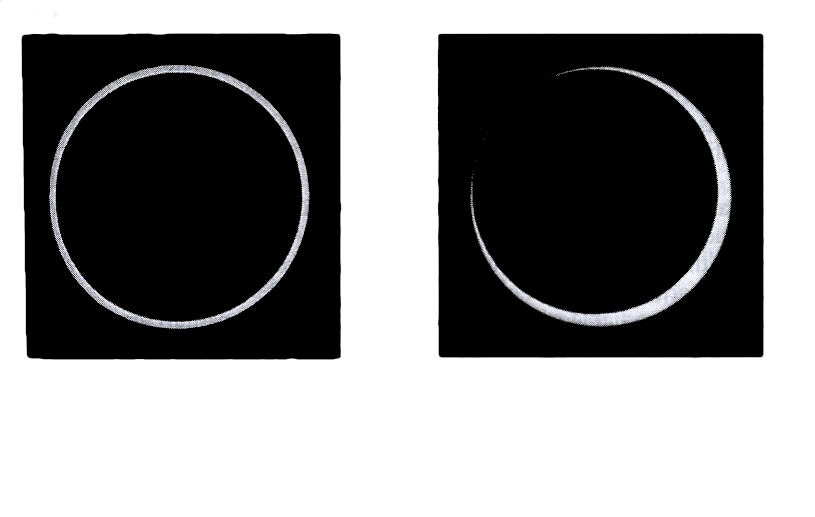
There are several interesting astronomical events coming up this year. Two interesting ones are an "annular" eclipse of the Sun late in the afternoon on May 20 and a transit of Venus across the Sun (again, as seen from Earth). The best place to see the annular eclipse would be for us to go to Redding, California, or Reno, Nevada, but we'll see a partial solar eclipse from Vancouver, too. The other event, the transit of Venus directly across the Sun on June 6, will again happen late in the afternoon. It will be visible from Vancouver, starting about 5 pm, and lasting into sunset.  Spanish Banks or any place with an open view of the Salish Sea (Georgia Straight) is a good spot from which to observe. This is the second of a pair of transits 8 years apart. The last one (the first of this pair) occurred on June 8, 2004.  The first one of the next pair happens on December 11, 2117, the second one of that pair on Dec 8, 2125.  I  don't think that I'll wait for those.


Annular solar eclipse, picture taken by RASC member Roy Bishop in 1994 near Sambro, Nova Scotia.


This image of the transit of Venus was taken by Murray Paulson, of St. Albert, Alberta,  at Hersonissos, Greece, on June 8, 2004


Both images taken from the Observer's Handbook 2012 published by The Royal Astronomical Society of Canada, editor David Chapman, printed in Canada by Webcom, Inc.

Tuesday, December 13, 2011

The December 10, 2011 lunar eclipse

Any hobby usually requires some "sacrifice". In my case, astronomy normally requires that I be awake and up while it's dark outside (the exception is when I'm using my telescopes to look [safely] at the Sun). A lunar eclipse always takes place when the Moon is full; the Moon is always exactly opposite the Sun then. At this time of year, the Sun rises low in the SE. That means that the Moon sets high in the NW.

This month's lunar eclipse occurred a couple of hours before sunrise, and I could watch it through my west-facing office window. I set up one of my cameras (a Canon Rebel XT SLR) and took some pictures through the double-paned window, and through breaks in the clouds. Before the eclipse started, the sky had been absolutely clear, but, just around the start of the eclipse, heavy clouds began to roll in. This is Vancouver, after all. Midway through the eclipse they totally obliterated any view of the eclipsed Moon. I got only one good picture through the last cloud break. These clouds kept the day dark and gray right through the next night, until the next morning.

Here are some of the pictures:

From the top down:


The Moon before entering Earth's shadow. The area at "11 o'clock" is getting darker.
Clouds are rolling in.
Three quarters into the Earth's shadow. Picture taken through a break in the clouds.

About 5 minutes before "totality" (again a break in the clouds). The star under the Moon is Iota Tauri (Iota in the constellation of Taurus, the bull)
The last "hole" in the clouds. The clouds to the right of the dark tree covered the Moon a short time later.
Midway through totality. This picture was taken just after the one above. About half-way through totality - the Moon has moved, so now is totally covered by the Earth's shadow. The brighter part of the Moon is closer to the edge of the shadow. Notice that the star Iota Tauri is now farther away from the Moon - it's a consequence of the Moon's motion in its orbit.

This is my last picture of this eclipse. A minute later, the Moon was completely covered by clouds and no longer visible.

The orange colour of the Moon in the Earth's shadow is due the sunlight being "refracted" by the Earth's atmosphere onto the Moon's surface. If you were on the Moon, you'd see the dark disk of the Earth surrounded by a reddish-orange ring (a circular sunset). From the Moon, this event is a total eclipse of the Sun. You'd have an awe-inspiring sight.


 The top picture was taken about two hours before the bottom one. It was a cold morning outside. This kind of thing did not bother me in the past, but now, in my old age, I enjoy creature comforts much more. I was glad to witness this in my nice, warm office.

Thursday, February 21, 2008

Eclipse luck

Last night, as mentioned in one of my previous posts, the last total lunar eclipse for the next three years took place. The weather had been predicted to be cloudy, but about an hour before totality, the clouds started breaking up. Derek and I set up our cameras on our back porch, from where we had a clear angle of view. As the eclipse progressed, the cloud holes got bigger and bigger, so that by the time of totality we got a clear view for almost the whole length of the total phase. Clouds started to roll in about six minutes before the end of totality, and we missed the partial phases which followed.

Derek's wide angle shot of the eclipse.


About four minutes before totality. The sharp edge of the earth's shadow appears at the lower right of the moon. Exposure was 3/10 of a second at f11.

Derek and I got about 100 pictures between us. I was using my tried and true Celestron C90 telescope, coupled to my Canon Rebel XT (350D), Derek his Nikon D50, with a 210 mm zoom lens. Derek's images are here.
The picture (left) shows the moon around the middle of the total eclipse. The lower edge is brighter because it is nearer the edge of the earths shadow, through which the moon was moving at the time. Exposure time was 1 second, ISO 800, the scope is a fixed f11, 1,000mm focal length. Because the Rebel XT has a CCD area smaller than that of a 24x36mm film, the effect is about like that of a 1,500mm telephoto lens.


Here's my series:


DPP_0010DPP_0011DPP_0012DPP_0013DPP_0014DPP_0015DPP_0016DPP_0017DPP_0018DPP_0019DPP_0020DPP_0021DPP_0022DPP_0023DPP_0024DPP_0025DPP_0026DPP_0027DPP_0028DPP_0029DPP_0030DPP_0032DPP_0033DPP_0034DPP_0035DPP_0036DPP_0037DPP_0038DPP_0039DPP_0041DPP_0042DPP_0043DPP_0044DPP_0046DPP_0047DPP_0048DPP_0049DPP_0050


Usually, when the weather forecasters are wrong, the error leans towards bad weather. This time, they were wrong and it turned into better weather - I can live with THAT. To see the eclipse, after expecting not to, felt like serendipity.